Friday, September 20, 2019

magician king trois

According to an earlier blog post, the first time I read The Magician King (book 2) I was a little disappointed when I compared it to The Magicians (book 1). Where the first book was vibrant and new, the second was a combination of catching up with a character--Julia, who had fallen off the page in the first book, and was now back--and following Quentin through the next stage of his life. Quentin is on a quest to save the world, or something just as critical, but he wasn't exactly sure what his task was until he neared the end. and neither were we

Quentin and Julia both grew as people in this book, and while it wasn’t as exciting as the first book, it was entertaining. I was also interested to read (in the earlier blog entry) that I suspected, but wasn’t yet sure, that there would be a third book.

The second time a read book 2 was just after book 3 came out and I may have rushed thru it. At that point, I still saw it as a 'middle book' of a trilogy, in the ways I’ve described that about other books in the past. This time through (the third time) I didn’t feel that; this time The Magician King read as a stand alone and moved the characters and overall storyline forward in a way that was hard to see without the benefit of the foreknowledge of book three that I now have.

Julia’s life, and story of the keys (Quentin's quest) read like a well formed adventure of its own, similar in to the individual books in The Chronicles of Narnia, which is one of the obvious inspirations for this series.

Read this book. yay, you got a promotion! who's a good book?

Wednesday, September 18, 2019

the magicians tres

So it its been a few years, and I decided to re-read Lev Grossman's Magicians Trilogy. This is partially because they made a Syfy series from the books (you can see it on Netflix) that I have found entertaining, but a little too 90210-ish for my tastes. They've also gone a bit off the rails in terms of following the books, but then again, different possibilities or storylines, is specifically discussed in the books, so I guess its just a different timeline/universe the Syfy show is about.

I'm not going to dive too deep into these books, as I've written about them before, but I did get a slightly different sense this time of the overall story arc, and the growth and maturity of Quentin Coldwater, in particular. I will also say that Grossman's dialogue is spot on, the banter and sarcasm of the young characters is hilarious. This is the third time I've read The Magician's since 2011, so your boy Lev is doing something right.

It holds up! I was not disappointed.

You can read my 2011 thoughts on this one here.

Saturday, September 14, 2019

einstein's dreams

Einstein's Dreams is a cute little novel by Alan Lightman, about the dreams Einstein has in the weeks surrounding the publication of his theory of relativity. Lightman imagines Einstein working through various scenarios involving time, and what it would mean if he was wrong. 
 
Night after night, Einstein dreams of how his town and its people might deal with time that runs backwards, or if it skipped around randomly rather than moving always forward. These dreams are nearly all that occurs in this story, other than a short introduction describing Einstein's discussions with his friend Besso, to which he returns to a few times over the weeks, for coffee or lunch, to discuss his dreams. So the novel reads like a dream journal, as dictated to his friend. Each interlude with Besso is also illustrated with a great little townscape--of Bern, presumably--but the illustrator is not credited and I can't find them on the interwebs either.

Lightman digs pretty deep into the science in these little fables of life and how it would be if we knew the future before it arrived, or if we lived backward through time, or in circles, endlessly repeating our lives. Its a fun little book.
 
 
PS: It seems like this book was a popular item for art students and graphic artists to illustrate as a project. Many examples of the artwork this book created are online.

Tuesday, September 3, 2019

indispensable wisdom

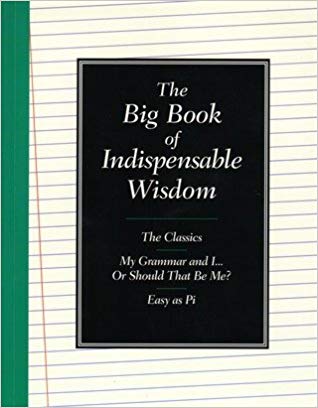
The Big Book of Indispensable Wisdom, is a collection of three books, published by Reader's Digest. I'm not sure where this book came from, but its been sitting on my shelf for a few years. The three books are: The Classics, My Grammar and I...Or Should That Be Me?, and Easy as Pi.

I know, its adorable.

There are a series of authors, and copy editors involved, so lets just say that these three books were edited by Pamela Johnson. Each has its own focus, but all of the subject matter is treated the same: 'You know this stuff, we're just going to remind you what you forgot since high school, and have a laugh doing it!'

None of the three subjects is explained in any depth. I think the idea is to cover as much ground as possible, and give the reader a framework to organize their own thoughts and memories on these subjects that we already (should) know. There were a few trinkets and additives that were new to me, and that was fun. All in all, it wasn't an awful read, and it certainly didn't read like a text book, but I certainly didn't find myself laughing along with the crummy jokes and enjoying myself. I finished, I guess that's something.


Sunday, August 25, 2019

kim

I don't think I've read Rudyard Kipling since I was a teen; that was probably Captains Courageous. A quick look at the Books page here on the blog tells me I'm wrong; I read The Jungle Book; Just So Stories in 2010, but didn't write about it. Anyway, I guess you could compare Kim with The Jungle Book, in that it focuses on a young man or boy in India. In both stories the boy has 'gone native' and ends up moving toward a more civilized (less wild) life as a young man. Perhaps its a parable on how we all grow: from a life of play and fantasy as a child, to the norms of society as an adult.

Perhaps they're just boy's adventure stories.

Kipling was born in India during the British rule (1865) but was sent back to England as a 6 year old for his education. He returned to India at 17, and worked there as a journalist and poet until he returned to London as a well known author at 24. So he spent some formative years in India, and you can see why he focused some of his well known stories on young men in India.

Kim (Kimball O'Hara) spends his early life as a street urchin, begging for his meals, and doing odd jobs where he can get the work. His street savvy has caught the attention of a horse dealer, who keeps his eye on the young Sahib, living as a local, and speaking to vernacular.

The story takes place over a number of years (roughly 1898 to 1902) and across a huge swath of India, from the Himalayas and Umballa (Ambala) down through New Delhi and Lucknow, to Benares (what is now Varanasi.) By train, and often on foot, either on an errand for the horse trader, or in the company of a Tibetan lama, whom he adopts and becomes a chela (guide) for in the lama's quest. In time, the lama, the horse trader, even a wealthy widow with her own children and grandchildren, become a kind of family to Kim who has lost his own family. They help him find purpose, education, and an connection to his lost European roots while allowing him to remain true to his 'street' self when he needs to. In the end, Kim even finds wisdom.

There is more to it than that, including a cloak and dagger theme that runs through the book, that I wont get into. I was a little surprised by it, but it gave the story I depth I wasn't expecting when I got into it.

Read this book.


Monday, August 19, 2019

the stranger

The Stranger (L'estranger) by Albert Camus, translated by Matthew Ward, is a small book, only 123 pages, but its a chilling, tightly written glimpse into the mind of a what, sociopath? pschopath? I don't know well enough to tell. I'm not sure we had the words to describe the man Camus tells this story about in the 1946, maybe we did. Again, I'm not the person to say. I'm sure the interwebs knows.*

Its written is short, staccato sentences, especially in the first half, that according to Ward, the translator, Camus based on what he called the 'American Style.' So we find ourselves wandering along with this fellow, as he goes off to the funeral of his mother, spends some time at work, with neighbors, at the beach, and with a girlfriend.

Told in the first person, after a while its becomes clear that our man Meursault may be lacking in empathy, but its goes further than that. Stranger is right; Camus tells a tale of a man that just doesn't seem right, and in the end, isn't really right at all.

It was creepy, but a good read. Thanks to Lino for loaning me this book. I apologize for keeping it so long.


* Looks like psychopath is closer to what I was thinking. Thank you internets.

Sunday, August 18, 2019

road to mercy

My wife likes the action novels of the detective and spy variety, and she can read a book in a day, so someone that can crank them out is a plus. So we have a lot of books around the house by writers like Danial Silva, Lee Childs, Brad Thor, and today's writer; David Baldacci. The Long Road to Mercy is the entrance novel for a new character, which I assume we'll be seeing again, Atlee Pine. Pine is an FBI agent, who likes to work alone rather than in a big office somewhere like New York or Los Angeles. She would also prefer her territory to be less populated as well, so she works in a remote FBI office, not far from the Grand Canyon, and has a significantly larger physical area under her jurisdiction.

Atlee Pine's resources are limited, her office furniture is worn out, and possibly second had, and her office assistant is a hot ticket. We'll be seeing more of Carol Blum too, I'm sure. Pine has made friends with the local law enforcement folks as well, and where she is, that includes the sheriff's department, Navajo Nation Police, US Park Rangers, and some ICE agents that also rent space in the same building as her office. These local friends act as a kind of emergency back-up system Lee can turn to in a pinch, and they can turn to her as well.

Pine is described as a 6-foot-plus, beer drinking, competitive weightlifter that almost made the US Olympic team, who has some pain in her past. Blum is an older, smaller woman, with six adult children, no husband, a selection of skirt-suits and pantyhose she wears to work, and has no problem making and/or delivering the coffee.

This story begins with an incident down in the canyon, that seems more odd than anything else, but soon appears to be much more than it appeared to be. The Park Rangers call on Pine to help with some of those oddities, and Pine soon discovers that things just don't add up. Overall, I thought this was pretty good, and I'd read another of Atlee Pine's adventures without hesitation. I'm sure my wife will bring one home at some point.

other woman

The Other Woman is a Gabriel Allon novel by Daniel Silva. I actually read this one before,* and I even came to this blog to check, but I guess I hadn't written about it, or maybe I did but I just couldn't find it. Oh well, its on here now.

True to form, Silva has written another story of international espionage of a scale that has the potential to unhinge the world as we know it, and who does the world look to to solve it, but the Israeli intelligence service, because (as Silva would have us believe) they are nimble, technologically advanced, and ruthless enough to get the job done without splashing it all over the front pages of the worlds newspapers. if there are such things any more

The other reason a 'third party' is needed is because there are potential implications for both the American and British secret services, MI6 and the CIA, respectively. And they would both like some distance, if not complete deniability. That's where our man Allon comes in, and not only that, if things go well, Allon is known to be happy to let the credit fall to his American or British counterparts as the case may be.

In this case however, I think those two services would rather drop through a hole in the ground and disappear as what this case quickly turns into is a mole hunt; a mole that may have, and probably has, compromised both the American's and the British, given their close ties. This one has some good twists and turns, and a great backstory that helps tie it into reality and give the story some depth.


* Not long after re-reading this, I went in search for something else to read and found two other books my wife bought, and found that I had read both of those as well, some time in the last year. I guess I'm getting sloppy maintaining this blog, I only wrote about one of them. I haven't written about Hidden Order by Brad Thor. If I remember, I'll add it to the year's reading list


lost things

The title of this book gives a pretty good idea about the kind of story you're about to get into, but its also the title of a mysterious book in the story. The Book of Lost Things is, like many of those stories where young people find a doorway into a magical place, is presumably written by the main protagonist after his adventures in the alternate universe he has discovered. The place our young man has found, is decidedly darker and more grim than the more familiar Narnia, Wonderland, or Neverland. The door to this place opens when the when the land of stories begins to bleed into our world.

And that only happens when a young person begins to suffer from sorrow and loss, which can sometimes bring on envy, and even hatred of another young person they've come to blame (wrongly) for their losses. Hmm... if that kind of child on child hatred is something that helps to crack open the door between the worlds, then whatever is drawn to it from the other side can't be good. yeah, its not

John Connolly has put together a pretty creepy book, that reads a little like a young adult story written for adults. Its all the creepiest parts of Grimms Fairy Tales (and other old stories) reimagined as the even nastier 'real' stories that inspired the fairy tales. David brings these stories with him into the world of stories, along with his own demons, and they blend together in a series of adventures that seem to be leading him toward some kind of conclusion.

As David makes his way through this world, meeting, heroes, monsters, witches, and wolves if he's actually heading back toward home, which he says that he wants, or if he is actually being drawn further into an imaginary world he may not be able to escape.

This story is creepy (as I said) wild, funny, satirical, sweet and sometimes sad. Its a lot like the fairy tales that inspired it, as I guess you'd expect. Connolly has done a great job of spinning a yarn that is both familiar and new.

Bonus: The backmatter in this book includes Connolly's analysis of the various fairy tales he used in the story, what he took from them, and then the text of the original fairy tale itself.