Mating is a novel by Norman Rush from 1991, set in Botswana in the early 1980s. This one won the National Book Award for 1991. Rush tells this story first person, from the POV of a graduate student from Stanford University, struggling with her doctoral thesis in nutritional anthropology. I guess that's a thing
Mating is an interesting look at the native lifestyles of southern Africa, how foreigner's perceive and interact with it, and how the local's feel about foreigners in their country. But more importantly, Mating is about love, how it feels, and how it changes people.
The text in this book is dense, and Rush assumes a huge general knowledge of the world, literature, academe, and foreign phrases! Dude, French AND Latin, and if I remember correctly a smattering of other languages, including Italian. Oh and don't forget Setswana and Afrikaans.* All dropped into casual conversation. Umberto Eco, I'm looking at you.
I really enjoyed this one, but man, it was dense, and it took a while to read, but in the end I'm glad I did. Rush spent some time in Africa, and drew on his experiences there I'm sure, and you can feel that knowledge of local culture, custom, and foods in every paragraph.
* Pro Tip: There is a glossary of Setswana and Afrikaans words, phrases and acronyms at the back of the book. I found it after I finished reading and thought: This would have been handy.
book reviews, bookmark collection, discussions about libraries, library design, information technology... and robots.
Monday, February 25, 2019
Saturday, February 9, 2019
sunbeam
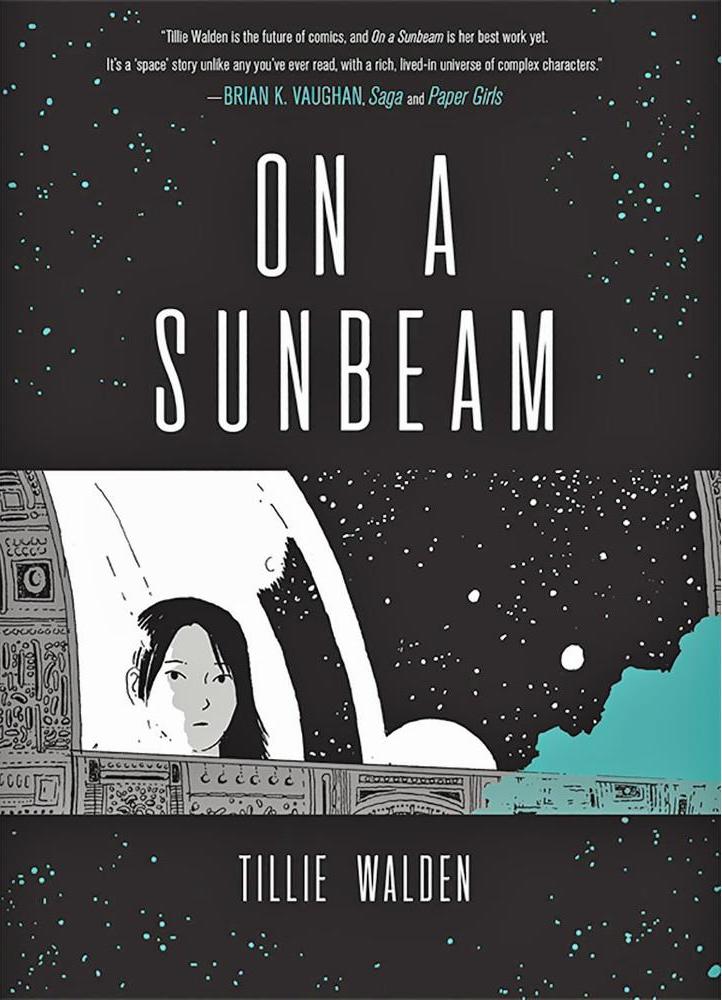
On a Sunbeam is a graphic novel by Tillie
Walden and it is both visually lush, and touching in its sensitivity to
its subject matter.
Let’s take those things one at a time. The
‘graphic’ in graphic novel comes first and its fitting I think,
especially in this case. Sunbeam is science fiction story set in a
universe that seems to include Earth, but the area
of space where this story takes place seems very remote from Earth, and
remote even from planetary physics as we understand it. Little chunks of rock,
sometimes with room for only a building or two, seem to float around in
space, some occupied, some not. Many of these
building are in need of restoration, and that’s where Mia and the rest
of the crew on their fish-looking ship come in.
The palette is subdued,
using just 3 or 4 colors, mostly black, normally speckled with stars or
star-like speckles of who knows what. Even in
daytime, if there is such a thing here, star strewn skies float
overhead, are glimpsed through windows and portholes, and sometimes seem
to linger between two people as they talk. Often, the starscapes are
strewn with twisting, colored storms of cloud and dust. The old buildings and ruins are drafted with care and an attention
to perspective that makes me think they were first modeled with a
program like SketchUp.
You can just gaze at this book, at the velvety black, other-worldliness of it. Good on you Tillie Walden.
The fiction part of the story follows our
hero Mia through various stages of her life. It’s centered on her work
as a new recruit on board a ship named Sunbeam as they work on building
restoration and then move on the next job.
The human story is based on the relationships Mai forms with her
shipmates and is punctuated by her memories of her 9th grade year in
boarding school--and the relationships she formed there.
Those two story lines then progress and spin
together, and we see the perspective changing in both the Mia of the
present and the Mia of the past. The message is clear; we’re always
growing.
And sometimes it takes growth to know when it’s time to go back to something you may have missed along the way.
Mia is fierce, loyal, strong, sensitive, forgiving, and both spontaneous and thoughtful. When Mia hugs someone who was keeping her from someplace she desperately wanted to be, after keeping her against her will, I almost fell over.
Read this book, and gaze at the artwork.
Labels:
architecture,
art,
books,
design,
read this book,
reading,
science fiction
Monday, February 4, 2019
oresteian trilogy
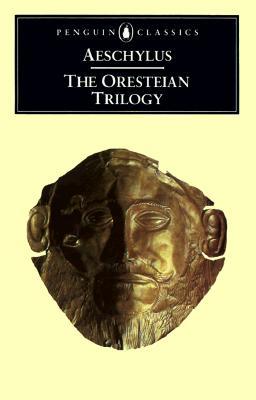
The Oresteian Trilogy consists of three plays, translated from ancient Greek; Agamemnon, The Choephori, and The Eumenides. These plays, written by Aeschylus (525 - 456 BCE) tell of the tragedy that befalls Agamemnon and his family shortly after his return from the 10 year battle in Troy. Paris has been defeated, Troy sacked, and Cassandra taken as spoils of war back to Argos (Mycenae) and his wife Clytemnestra, sister of Helen.
You'll recall that Agamemnon went to Troy at the request (demand) of his brother Menelaus, King of Sparta, whose wife, Helen was stolen by Paris during a visit to Sparta for a wedding. Menelaus was obviously pretty peeved to lose he wife like this, and demanded the armies join him in marching on Troy to punish Paris and retrieve his queen. This bit is told in The Iliad, and because that story was as well known then as it is now, Aeschylus could skip to the days before Agamemnon arrived home.
Why is it, that after 10 long years beneath the walls of Troy, watching countless other men die in battle, including his brother Menelaus, Agamemnon has to travel all the way back home in victory before tragedy catches up with him? Well, that has to do with the curse on his family, that extends back to his grandfather Tantalus, who feasted with the gods, and then betrayed their secrets to mortal men. And it doesn't end with him, but with his children; Iphigenia, Electra, and his son Orestes, for whom the trilogy is named.
Because this story is so well known, is apparently why Aeschylus chose it to teach the populace about justice. Not the eye-for-an-eye justice of the ancient gods, but the modern justice of the emerging Greek democracy. Aeschylus weaves the ancient and modern ideals together, and like any persuader worth his salt, uses the believes of the people as a bridge to a new way of thinking. Conscripting Athena herself as the voice of justice, forming the very first court of justice, with 12 citizen jurors to decide the fate of Orestes, and finally bring an end to the family curse.
Because Aeschylus has an agenda, he's had his with the story and the characters to suit that agenda, so the stories in these three plays do not align with much of the popular Greek myths concerning these characters. 3000 year old fan fiction?
Translated from Greek by Philip Vellacott, who also wrote the introduction.
You'll recall that Agamemnon went to Troy at the request (demand) of his brother Menelaus, King of Sparta, whose wife, Helen was stolen by Paris during a visit to Sparta for a wedding. Menelaus was obviously pretty peeved to lose he wife like this, and demanded the armies join him in marching on Troy to punish Paris and retrieve his queen. This bit is told in The Iliad, and because that story was as well known then as it is now, Aeschylus could skip to the days before Agamemnon arrived home.
Why is it, that after 10 long years beneath the walls of Troy, watching countless other men die in battle, including his brother Menelaus, Agamemnon has to travel all the way back home in victory before tragedy catches up with him? Well, that has to do with the curse on his family, that extends back to his grandfather Tantalus, who feasted with the gods, and then betrayed their secrets to mortal men. And it doesn't end with him, but with his children; Iphigenia, Electra, and his son Orestes, for whom the trilogy is named.
Because this story is so well known, is apparently why Aeschylus chose it to teach the populace about justice. Not the eye-for-an-eye justice of the ancient gods, but the modern justice of the emerging Greek democracy. Aeschylus weaves the ancient and modern ideals together, and like any persuader worth his salt, uses the believes of the people as a bridge to a new way of thinking. Conscripting Athena herself as the voice of justice, forming the very first court of justice, with 12 citizen jurors to decide the fate of Orestes, and finally bring an end to the family curse.
Because Aeschylus has an agenda, he's had his with the story and the characters to suit that agenda, so the stories in these three plays do not align with much of the popular Greek myths concerning these characters. 3000 year old fan fiction?
Translated from Greek by Philip Vellacott, who also wrote the introduction.
Saturday, February 2, 2019
night squad
Before Corey Bradford was kicked off the police force, he had his way with some of the folks in the slummy part of town where he grew up, affectionately known as the Swamp--a bribe here, a shake down there. Now that Bradford is off the force, he's lost his wife, and has ramped up his drinking. Now, being in the wrong place at the wrong time has put Bradford right between the crime organization that runs the Swamp and the police department he used to work for.
Then the Night Squad came looking for him.
This is 1961, hard core crime noir. The honky-tonk lingo, the cruel reality of the ghetto, the .38 specials, and the platinum blondes are all here. I haven't read a hard boiled crime novel in a while, and there really is something to these pulpy crime fiction novels from this era. David Goodis doesn't waste words, and he doesn't spare feelings. The inner dialog is a little over wrought, but it really gets to the core of Bradford's feelings as he moves his way through this story, trying to find the best way forward for number one.
Goodis writes the Swamp as an integral part, or even a character in the story. The teaser line on the original book jacket calls the Swamp: "...the brutal throbbing heart of the slums." There are plenty of sad, sorry stories in the Swamp, and Bradford just wades through them as gets on with his life there. There are glimmers of what life could be, buts its never clear if those glimmers hold any hope for Bradford, or anyone else who lives there.
Sunday, January 27, 2019
gatsby
The Great Gatsby is a small novel, but artistically, its a study of personalities and a writing gem. I haven't read Fitzgerald's stuff before, but looking at some of the titles, he seems to be interested in a particular slice of 1920s sub-culture: rich men living around the edges of society through ill gotten, or at least questionably gotten gains. That idea is solely from what I've taken from Gatsby and the titles of his other books, like The Beautiful and the Damned, and The Love of the Last Tycoon, which Fitzgerald was working on when he died at forty-four.
Fitzgerald seems to say, hey, you've been to (or witnessed) these parties, you've seen these people, here's what they're really like. For all of those who have looked on as the rich whiz by in their fancy cars; watched as their huge parties lit up the neighborhood sky and raged into the early hours with all of society except them, Fitzgerald says: See, they're not so different from you and I. Although F. Scott Fitzgerald did run with that crowd--he and his wife Zelda Sayre Fitzgerald split their time between fancy upscale living on the east coast and in Paris--he does seem to be able to separate himself enough to write about it.
Zelda, incidentally, was also a writer, as well as a painter and an all-around kick-ass woman. She seems to be at least as interesting a person (if not more so) than her husband. I may have to take a look into her.
The book is narrated by Nick Carraway, and working man from a well-to-do family in the mid-west, summering in New York to work in the city. He happens to be neighbor to Gatsby, and is soon drawn into Gatsby's orbit, and thereby represents the every man perspective, peeking behind the curtain of this flamboyant, rich lifestyle.
This book is less than 200 pages, so its a quick read. Thinking back on it, its amazing how many different personalities are studied. Not just the main characters, but many of the second tier or supporting characters are also dissected and examined as they relate with, crash into, and sometimes bounce off their rich and mighty peers. Its a tragedy of Shakespearean scope if not scale.
Read this book. If you read it in high school, read it again.
Fitzgerald seems to say, hey, you've been to (or witnessed) these parties, you've seen these people, here's what they're really like. For all of those who have looked on as the rich whiz by in their fancy cars; watched as their huge parties lit up the neighborhood sky and raged into the early hours with all of society except them, Fitzgerald says: See, they're not so different from you and I. Although F. Scott Fitzgerald did run with that crowd--he and his wife Zelda Sayre Fitzgerald split their time between fancy upscale living on the east coast and in Paris--he does seem to be able to separate himself enough to write about it.
Zelda, incidentally, was also a writer, as well as a painter and an all-around kick-ass woman. She seems to be at least as interesting a person (if not more so) than her husband. I may have to take a look into her.
The book is narrated by Nick Carraway, and working man from a well-to-do family in the mid-west, summering in New York to work in the city. He happens to be neighbor to Gatsby, and is soon drawn into Gatsby's orbit, and thereby represents the every man perspective, peeking behind the curtain of this flamboyant, rich lifestyle.
This book is less than 200 pages, so its a quick read. Thinking back on it, its amazing how many different personalities are studied. Not just the main characters, but many of the second tier or supporting characters are also dissected and examined as they relate with, crash into, and sometimes bounce off their rich and mighty peers. Its a tragedy of Shakespearean scope if not scale.
Read this book. If you read it in high school, read it again.
Thursday, December 27, 2018
the escape
The Escape is the third in the John Puller series by David Baldacci. I haven't read the first two, but this one was pretty good. My wife is a fan of Baldacci and she has picked up a number of his books, and I usually find them around when I'm looking for something to read. She found me reading this one and after checking out the text on the back cover to jog her memory, she said that this was a good one.
John Puller seems like a good character, by the time we get to the third in his series anyway. There are a fair number of throw away characters in this book that I get the impression aren't carried over from previous installments, and may never show up again. That's not a bad, thing just an observation.
The story has a mystery to it, or at least an problem that needs to be unraveled so that we can get a look at who the bad guys are, and as one would expect in a story like this, there are few twists and turns along the way which kept the story riding pretty high on plot twists, but some of them I could see coming.
All in all, a good effort. If you're a Baldacci fan, I think you'll like this one.
John Puller seems like a good character, by the time we get to the third in his series anyway. There are a fair number of throw away characters in this book that I get the impression aren't carried over from previous installments, and may never show up again. That's not a bad, thing just an observation.
The story has a mystery to it, or at least an problem that needs to be unraveled so that we can get a look at who the bad guys are, and as one would expect in a story like this, there are few twists and turns along the way which kept the story riding pretty high on plot twists, but some of them I could see coming.
All in all, a good effort. If you're a Baldacci fan, I think you'll like this one.
Friday, December 21, 2018
spiders web
After the death of Stieg Larsson in 2004 of a heart attack, I assumed we'd seen the last of Lisbeth Salander and Mikael Blomkvist.*
Nope.
I guess there was just too much juice in these stories to give up on them. According to Eva Gabrielsson, Larsson's long time girlfriend (who apparently also helped with his story development) Larsson had plans for seven more books in the Millennium Series. The Girl in the Spider's Web is the latest installment, penned by Swedish author and journalist, David Lagercrantz, and translated in to English by George Goulding. Goulding is also a switch from the original translator of Larsson's efforts in the series, which were done by Reg Keeland.
I will admit that its fun to Have Lisbeth Salander back, but I'm sorry its not really her. Lagercrantz does a pretty good job, but this story just didn't have the depth of the Larsson stories. This story moved quicker perhaps, but that may be because not as much was happening. Lagercrantz has also introduced some new backstory elements, that I believe he will use to further the overall story arc as he writes more of these stories. Whether these new elements are based on discussions with Larsson, research in his notes, or speaking to someone who may know, such as Gabrielsson, I don't know.
What I do know is that I'll probably read the next one, if and when it shows up in my house, or perhaps at the library book sale, but I'm not in a hurry to do so. Here's hoping Lagercrantz just needs to warm up a bit.
* We have, unfortunately, seen the last of Mikael Nyqvist who played Mikael Blomkvist in the 2009 movie adaptations of the Millennium Series.
Nope.
I guess there was just too much juice in these stories to give up on them. According to Eva Gabrielsson, Larsson's long time girlfriend (who apparently also helped with his story development) Larsson had plans for seven more books in the Millennium Series. The Girl in the Spider's Web is the latest installment, penned by Swedish author and journalist, David Lagercrantz, and translated in to English by George Goulding. Goulding is also a switch from the original translator of Larsson's efforts in the series, which were done by Reg Keeland.
I will admit that its fun to Have Lisbeth Salander back, but I'm sorry its not really her. Lagercrantz does a pretty good job, but this story just didn't have the depth of the Larsson stories. This story moved quicker perhaps, but that may be because not as much was happening. Lagercrantz has also introduced some new backstory elements, that I believe he will use to further the overall story arc as he writes more of these stories. Whether these new elements are based on discussions with Larsson, research in his notes, or speaking to someone who may know, such as Gabrielsson, I don't know.
What I do know is that I'll probably read the next one, if and when it shows up in my house, or perhaps at the library book sale, but I'm not in a hurry to do so. Here's hoping Lagercrantz just needs to warm up a bit.
* We have, unfortunately, seen the last of Mikael Nyqvist who played Mikael Blomkvist in the 2009 movie adaptations of the Millennium Series.
Thursday, December 6, 2018
deathly hallows
Harry, Harry, Harry.
You old scamp.
Harry Potter and the Deathly Hallows is book seven--the last installment--in the Harry Potter series. can she really resist, do you think? Harry, Hermione, and Ron have their work cut out for them in this one. Rowling does a good good of building toward the climax, altho our heroes may have escaped Coldisnort by the very skin of their teeth one too many times for my taste, but this is a kids book after all. My kids had no such concerns when I read this to them first time through.
J.K. Rowling has created a series that is fun, exciting and accessible for kids, with a storyline and plotting complex and well thought out enough for older readers. Moreover, the universe she's created is original, and carefully planned. It has history, depth, and a connection to reality that makes it fun for kids to wonder about what magical things may be lurking just outside their collective understanding.
Harry and company have been through a lot, and what we've learned about them is that they've grown enough to deal with the hardships they've been dealt. Dumbledore and their other teacher's knew they could do it, that they needed to do it, and they did. We were just along for the ride.
I'm not sure if this series will hold up over time, but I'm thinking that it will. I don't know if the books are as popular now as they were when they first came out, but I don't think that's ever the case. Are there more Potter stories out there? Who knows, Rowing has repeatedly said no, and I'm sure they haven't just been asking what her plans are, but rather begging her to make a plan to write more about our hero and his friends.
Read these books.
You old scamp.
Harry Potter and the Deathly Hallows is book seven--the last installment--in the Harry Potter series. can she really resist, do you think? Harry, Hermione, and Ron have their work cut out for them in this one. Rowling does a good good of building toward the climax, altho our heroes may have escaped Coldisnort by the very skin of their teeth one too many times for my taste, but this is a kids book after all. My kids had no such concerns when I read this to them first time through.
J.K. Rowling has created a series that is fun, exciting and accessible for kids, with a storyline and plotting complex and well thought out enough for older readers. Moreover, the universe she's created is original, and carefully planned. It has history, depth, and a connection to reality that makes it fun for kids to wonder about what magical things may be lurking just outside their collective understanding.
Harry and company have been through a lot, and what we've learned about them is that they've grown enough to deal with the hardships they've been dealt. Dumbledore and their other teacher's knew they could do it, that they needed to do it, and they did. We were just along for the ride.
I'm not sure if this series will hold up over time, but I'm thinking that it will. I don't know if the books are as popular now as they were when they first came out, but I don't think that's ever the case. Are there more Potter stories out there? Who knows, Rowing has repeatedly said no, and I'm sure they haven't just been asking what her plans are, but rather begging her to make a plan to write more about our hero and his friends.
Read these books.
Sunday, December 2, 2018
half-blood prince
Its book six!
Harry, Ron and Hermione have made it to their sixth year at Hogwarts. That is, after a little summer action to get this year going. Dumbledore has finally decided that Harry is old enough to get some background information is just why he is so darn special. is that why they wrote all them books about me perfesser? And it all comes from Voldemort, Harry's archenemy. He's the enemy of all people, actually.
Voldemort is a bad dude, that's pretty clear, and no matter what we've heard up to this point, there is always more badiness he's willing to do, just to remind Harry (and us) just how bad he is. Everything that Harry has been through has led him to this point, and Dumbledore is doing everything he can to help prepare Harry and friends for the rematch that must inevitably come.
But in the meantime, there are classes to take, potions to brew, spells, charms, and jinxes to learn, and that's to say nothing of all of the things that any normal 16 year old boy is obviously interested in when hanging out with a bunch of people his own age. are those girils perfesser?
J. K. Rowling takes the opportunity to begin lacing up some of the oldest, nagging questions and mysteries that she has sprinkled throughout the series, and Harry and his friends are eating it up. And they're left wanting more. That's right, there is one more book to go and Rowling has saved some of the good stuff for the finale. Book 4 is where this series stopped being a little kids story, and became a big kids story. Just look at the artwork on the covers. On the covers of the first three books, Harry is flying! wheeee It looks daunting to be sure but Harry looks young and cartoonish, and the images are colorful and fun. On the cover of book 4, Harry is smiling again. Its still colorful, but he does look more carefully drawn. The art itself seems more serious.
Book 5? Yikes, just look. Shades of deep blue, Harry looks serious, warily glancing over his shoulder. The wand held in what looks like celebration on the cover of book 4, looks a lot like a defensive weapon on the cover of book 5. And this book, book 6? That's a pretty grim color scheme, and again, the smile is gone. Harry and Dumbledore don't look like they're making a cake for the Spring Faire.
As I've said before, the stories seem to grow with Harry. Reading them when they first came out, with a year or so between the later books, my kids were growing at the same rate as the characters in real time, so they kept same pace as Harry got older and the stories more grown up. Reading to your own kids? 6 or 7 is probably old enough for the earlier stories, but that may be too young for these later ones, depending on their maturity.
Harry, Ron and Hermione have made it to their sixth year at Hogwarts. That is, after a little summer action to get this year going. Dumbledore has finally decided that Harry is old enough to get some background information is just why he is so darn special. is that why they wrote all them books about me perfesser? And it all comes from Voldemort, Harry's archenemy. He's the enemy of all people, actually.
Voldemort is a bad dude, that's pretty clear, and no matter what we've heard up to this point, there is always more badiness he's willing to do, just to remind Harry (and us) just how bad he is. Everything that Harry has been through has led him to this point, and Dumbledore is doing everything he can to help prepare Harry and friends for the rematch that must inevitably come.
But in the meantime, there are classes to take, potions to brew, spells, charms, and jinxes to learn, and that's to say nothing of all of the things that any normal 16 year old boy is obviously interested in when hanging out with a bunch of people his own age. are those girils perfesser?

J. K. Rowling takes the opportunity to begin lacing up some of the oldest, nagging questions and mysteries that she has sprinkled throughout the series, and Harry and his friends are eating it up. And they're left wanting more. That's right, there is one more book to go and Rowling has saved some of the good stuff for the finale. Book 4 is where this series stopped being a little kids story, and became a big kids story. Just look at the artwork on the covers. On the covers of the first three books, Harry is flying! wheeee It looks daunting to be sure but Harry looks young and cartoonish, and the images are colorful and fun. On the cover of book 4, Harry is smiling again. Its still colorful, but he does look more carefully drawn. The art itself seems more serious.
Book 5? Yikes, just look. Shades of deep blue, Harry looks serious, warily glancing over his shoulder. The wand held in what looks like celebration on the cover of book 4, looks a lot like a defensive weapon on the cover of book 5. And this book, book 6? That's a pretty grim color scheme, and again, the smile is gone. Harry and Dumbledore don't look like they're making a cake for the Spring Faire.
As I've said before, the stories seem to grow with Harry. Reading them when they first came out, with a year or so between the later books, my kids were growing at the same rate as the characters in real time, so they kept same pace as Harry got older and the stories more grown up. Reading to your own kids? 6 or 7 is probably old enough for the earlier stories, but that may be too young for these later ones, depending on their maturity.
Subscribe to:
Posts (Atom)