Showing posts with label philosophy. Show all posts

Tuesday, April 13, 2021

cowgirl blues

My first experience with Tom Robbins was when I was about 25 or so. Skinny Legs and All had just come out in paperback; my Mom and Dad had read it and its was making the rounds in my family. That would been around 1990-91, not long after that book first came out. Robbins is not one of those super-prolific, book a year or four a year kind of writers. Skinny Legs sits at the middle point of his 8 published novels, which span from 1971 to 2003. Robbins is getting close to 90 now, so maybe he has slowed down. I don't have high hopes that we'll see another novel, but who knows, the man is a genius.*

Even Cowgirls Get the Blues is Robbins's second novel, published in 1976. So how does this 45 year old book hold up? Wrong question. Sure, you can hear the crackle of Nixon/Ford, the sigh of the ERA's recent passage, the swish of polyester slacks, and the squish of the still young sexual revolution, positively pulsing in the pages of this book. But what sets it apart (other than the quirkiness) is the philosophical undercurrent. 

I don't know enough about Robbins to call him an anarchist or a hedonist, which are two that come to mind, but I think the former is more accurate than the latter. He does seem to advocate free love, but seems more interested in each individual's right to govern what is right for them, and to police ones-self by entering into relationships based on what is right for each of the participants. It seems clear that social constructs such as marriage and monogamy don't appeal to him. He seems to place larger social constructs, such as government and laws, in the same boat, along with more vague notions, like our collective notion of adulthood.  He goes as far as to say that a kind magic exists--or is even brought about by--the relationships that people have with those around them, and all the people, places, and things they come into contact with.

Sissy Hankshaw is the main protagonist in Cowgirls, and she was born with a gift that allows her to excel in her chosen field. So much so, that her understanding of, and her relationship with her chosen field expands to the point where it intersects with everything else. keanu-like whoa  This is another of Robbins's beliefs: it doesn't matter how you get there, as long as you can get there. Its another branch of the same theory: doing what is right for yourself.

Importantly, he ties all of these personal freedom issues together with a ribbon of peace. He clearly believes that the ideas he is advocating are for the self, and while he believes these idea should be shared he does not think they should be preached. he doesn't believe in any kind of preaching it seems Just as he does not think one should fight against what we don't believe in, only ignore it as much as possible. Its the long game: change not by revolution, not by revolt, but person to person. It seems like he believes that we can love one another to change.

Robbins's stories are peppered with strange facts, that he seems to have carefully researched and included in the story, almost arbitrarily; using these little know tidbits as analogies and metaphors for events in the story, in only the most stretched and contorted ways possible. They often come up at the ends of chapters, and there is little breaking of the fourth wall when it happens.

There is really too much to cover in a book review like this. Robbins seems to be winking at us with his impish grin on every page. This is the kind of book I imagine that Rolling Stone, Playboy and National Lampoon, all would have recommended when it came out.**

Surprisingly enough, Cowgirls was adapted into a movie directed by Gus Van Sant in 1993, with Uma Thurman playing Sissy Hankshaw. Not a big hit at the time; and 19% on the Tomatometer as of this writing. All star cast too. Should have been good, but maybe Robbins's ideas are just too difficult to capture in a movie.


Read this book. Then read the others.


* Tom Robbins was born in 1932, so he'll be 89 in July. He published a collection of essays in 2005, a novella about beer in 2009, and what he called an un-memoir in 2014.

** If anyone knows this, let me know in the comments .

Tuesday, September 3, 2019

indispensable wisdom

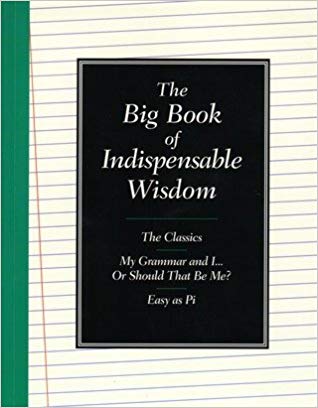
The Big Book of Indispensable Wisdom, is a collection of three books, published by Reader's Digest. I'm not sure where this book came from, but its been sitting on my shelf for a few years. The three books are: The Classics, My Grammar and I...Or Should That Be Me?, and Easy as Pi.

I know, its adorable.

There are a series of authors, and copy editors involved, so lets just say that these three books were edited by Pamela Johnson. Each has its own focus, but all of the subject matter is treated the same: 'You know this stuff, we're just going to remind you what you forgot since high school, and have a laugh doing it!'

None of the three subjects is explained in any depth. I think the idea is to cover as much ground as possible, and give the reader a framework to organize their own thoughts and memories on these subjects that we already (should) know. There were a few trinkets and additives that were new to me, and that was fun. All in all, it wasn't an awful read, and it certainly didn't read like a text book, but I certainly didn't find myself laughing along with the crummy jokes and enjoying myself. I finished, I guess that's something.


Monday, February 6, 2017

time being

A Tale for the Time Being is a novel by Ruth Ozeki that I borrowed from my office lending library. It looks like the kind of book that would have been in someone's reading group list of books. As usual, I come to these books late because I'm picking them up used, some years after they were popular. I'm not sure how popular this book was at the time, but it certainly reads like one that would get the attention of book clubs.

I don't think I'm giving anything away when I point out that very quickly in the text, it becomes clear that the phase 'time being' is a double entendre. in fact its noted at the top of the back cover on the paperback I read As soon as I read that, the Zen of this book started kicking in. This book is as much about an interestingly disjointed trans-Pacific relationship, as it is about philosophy. Think Zen and the Art of Motorcycle Maintenance. Yeah, like that.

Ozeki is writing her thoughts about Zen into this storyline, just as Pirsig did in his, but I think Ozeki does a better job of working the teachings into the narrative than Pirsig did in Motorcycle Maintenance. The other difference I'll point out is the story in this book is better too! Ozeki sets up a pattern of switching back and forth between two storylines, narrated by two people on different sides of the ocean. Its a one-sided relationship, and we can't help wondering what will happen next with each of these characters, and their supporting characters.

Its a story of loss, change, caring, moving away and what 'home' means, bullying, nature, war, coming of age, old age, dreams, Japan, suicide, and Zen. Its got a little of everything, and is just riveting.

Ozeki dances us right out to the edge, and teases us with a universe that is larger than we may ever understand, and then grounds us by reminding us that our finger is not the moon, but that they are, still, the same. Just as a man and a wave in the ocean are.

I really enjoyed this story, as a narrative, a conversation between different peoples, and as a primer for understanding eastern philosophy. Ozeki has a keen understanding of people, and does a great job building characters that have weight and depth.

Read this book. Move others out of the way, if needs be.

Saturday, December 31, 2016

the dispossessed

I'm trying to get down my thoughts on all of the books I've finished in recent weeks, but haven't had the time with the holidays, and being sick during the holiday week.

Merry Christmas to all, and Happy New Year!

I still have a number of books from Ursula Le Guin's Earthsea Cycle on my reading list, but I haven't seen them at my library and haven't had the time to bother asking for them to be delivered. This one however, I found in the library's book sale, apparently weeded from the collection. The Dispossessed is another of Le Guin's looks at society and its norms via SciFi. She has a knack for disassembling societal problems, winnowing them down to their core, and then rebuilding them in an artificial form so that she can examine them more clearly. In this case, she's created a twin world; two planets that revolve around each other--each the others' moon--one green and lush, the other dry and barren.

The green world, Urras, is much like ours, and 175 years ago, a band of dissidents who believe in freedom, and self rule, leave their home to colonize the dry world, Anarres, and build a new world of self rule, collective anarchy. Its a thought provoking look at pure social communism, with no centralized government, no rules, no currency, no ownership, and no laws, built around the believe that in order to be completely free, everyone must do exactly what they want, by agreeing as a society that part of what they want is to help and support one another. A collective anarchy.

After 175 years of this planet-wide experiment, Le Guin looks in at how a society like this might be faring, and compares and contrasts it with the world the anarchists left, and no longer have any contact with. The original colonists, and their children are long dead, and generations of people have been born and raised in this experimental society, completely untouched and uninfluenced by the governments and currencies of their home world.

One scientist from dry, isolated Anarres, decides that perhaps its time to re-connect with the people of Urras, and share what he has learned; the new science that he has developed. But Shevek finds that sharing and giving don't have the same meaning in a society based on currency and centralized governmental control. He also finds that having a new idea, which is normally celebrated in his own society, can be threatening, when that new idea includes reaching outside of that long closed society. Threatening to the isolationism that many on Anarres believe insulates them from the evils of Urras.

If you aren't interested in this type of outside look at anarchy, and what society means, this may not be for you, but if you can get past the preaching which underlies the story, the story itself is an interesting look at different ways of life. And some pretty hippy-dip space-time theory, which or may not, in some form, be actually pretty close to true.

Le Guin is still kickin' it at 87. She has recently released a collection of novellas entitled The Found and the Lost.

By the way, The Dispossessed is part of a series called the Hainish Cycle, but the order of this series of books, is a little loose, and from the way it sounds, not really critical. FictFact has it listed this way, why I'm not sure, as it seems to be in opposition to the advice from Le Guin herself on what order to read them in, if that is important to you in this case. For her advice, go here and search for the phrase "in what order should I read" or the word "Hainish."

Sunday, July 6, 2014

shadowings

I borrowed Shadowings by Lafcadio Hearn from my office lending library yeah we have a lending library and I didn't know what to expect. Half-way through, I still didn't know what to expect. Hearn is an international type guy. He was born (according to a Wikipedia article about him) on the Greek isle of Lefkada (presumably where his middle name comes from; full name Patrick Lafcadio Hearn) to an Irish father and Greek mother. He father happened to be stationed there during the British occupation in the 1840s. Lafcadio came along in 1850. A broken home and a re-stationed father left young Lafcadio bopping around for a while, until he made his way to the US in his late teens. A few years later he found work at a newspaper, and by 1890 was sent to Japan on a story, and he never left.

Hearn stayed in Japan and continued to write, and eventually took the Japanese name: Koizumi Yakumo. He became pretty well know internationally for his writings about Japan, and Shadowings is one of those books. Shadowings seems like a collection of whatever Hearn had on his desk when print time came, and maybe all of his books are like that. This volume includes translations, and re-tellings of traditional Japanese folks tales, the history and meanings of Japanese female names, and at the end a series of ghost stories and essays about dreams. Sometimes dreams about ghosts.

These essays at the end--which are written by Hearn, as opposed to researched and documented or translated, like the first half of the book--are where the book comes into its own. The essays are like a cross between Tom Robbins, Edgar Allan Poe, and maybe a little Carl Sagan or someone like that. He's very honest with himself, his writings are almost journal entries, and he's questioning and probing all kinds of things: life, and its meaning, the after-life, a higher-power (or lack thereof), reincarnation, love, humanity, and the nature of intellect. He even tries to figure out why Gothic architecture is gloomy, and does a thought experiment on the crowd behavior. This is a busy guy!

I didn't love this book, but it was interesting to read.

Sunday, February 9, 2014

zen and mortorcycles

I've been hearing about this book since not long after it was written, its seems. My wife read this in her first year of college and she found a used copy for me somewhere and its been sitting around for another year or so waiting for me to read it. Zen and the Art of Motorcycle Maintenance is a great title for a book, and I'm sure its what helped it to top the charts when it came out, and lends it staying power after all these years. Its still in print, and I would guess that its still being taught in college classes today.

ZAMM is a complex book I've been reading it since december but fascinating nonetheless. Its three stories really, woven together. Outwardly, its the story of a cross country motorcycle trip of a father and his young son,* but along the way, the father narrates a modern take on Zen philosophy from his own personal experience, and how it ties into, and is tied up with western philosophy. His own personal experience is his history, and how working through a personal philosophy drove him mad. The narrator also peppers his monologues, and occasionally his conversations with others, with motorcycle maintenance tips, which aren't very useful or complete, if truth be told, but they aren't meant to be. The author uses maintenance of the bike as allegory for the self. When he says you can't just ride and ride the cycle until it breaks down and then call for help, you need to understand the cycle; be responsible for it, maintain it as you go along as a matter of course, he's talking about ourselves.

Allegory is the go-to tool in the entire book, because the motorcycle trip itself is an allegory of the narrator's trip through life, his slip into madness, and his recovery. It can also be seen as a description of his relationship with his son, as well as the struggle to explain the complex philosophy he is building for his readers along the way. By the end, its clear that narrator himself could use a road map, and may have indeed, done himself some good by working through this tortured time of his life; he's made himself an example for us, to show us what self examination and self-maintenance can do for us.

Very interesting, but slow and methodical. The narrator says at the outset that the process wasn't going to be either simple or quick, and it wasn't. For as fascinating as it was, this book was a slog. After taking all of January and a little of February to get through this one, I don't think I'll be matching my personal best of 49 books in 2013.

Robert Pirsig has written a follow up, but I don't think many read it. The edition of ZAMM I read is the 25th anniversary edition, which includes a new forward by the author, as well as an afterword he penned at the 10 year mark, along with a short interview with him. Its interesting to see how his views of the book evolved over time.


* Pirsig really did take a cross country trip on his bike with his son Chris, and their friends John and Sylvia. He talks about how he decided to use the trip as a structure to hang his story on, well after he began to write it. The link I put in there leads to one of a few photographs from that trip you can find on the net.

Wednesday, May 29, 2013

tropic of cancer

According to Miller's brief autobiography, he began writing Tropic of Cancer while living in Louveciennes,  a western suburbs of Paris, where he met Anais Nin. He had left his second wife, June Edith Smith, at home during this time and lived on the streets of Paris, and slept, as he says, where he could. This was in 1931-2. During this time he worked at the Paris edition of the Chicago Tribune as a proof reader, and taught English for a while in Lycee Carnot. Nin was his lover during this period and kept him housed, fed, and helped finance the first printing of this book. Nin also wrote a short preface, which she ends by saying that Miller digs beneath the roots, for subterranean springs.

By 1933, Miller had visited  Luxembourg with his Clichy roommate, Alfred Perles, and begun work on Black Spring, and also a book on Lawrence which he never finished. His wife came back to Europe briefly, but left again after asking for a divorce. In 1934, Tropic of Cancer was published after a number of re-writes, a a decisive moment, in Miller's words. That was nearly 80 years ago. Tropic of Cancer could have been written yesterday. But if it was, no one would care; it could have only have been written then.

Miller writes with seeming abandon, using language that is both coarse and foul, and beautifully poetic. His prose is in many ways prose poetry. He talks about the underbelly of society and what it is to be a thinking, eating, sexual animal which lives in this society we've made for ourselves. He looks up from his depression-era squalor to the fat cats with 50 cent corona cigars, dripping juice down their faces, but not with hatred as you might expect, but with a journalist's impartiality. If he feels anything about the state of man, as horrible and useless as it all is, you could say its glee. He seems to laugh as he looks on, constantly amused by what he sees, as if he looked on the antics of young children, or dogs frolicking.

Miller lauds the works of those he sees as shinning examples in his prose, he talks of Walt Whitman as a poet who understood what is is to be a man, but worried that Whitman's language was now (in 1931) almost incomprehensible to modern readers. He also went on about Matisse, saying that he was at the very hub of the wheel that was falling apart around us.

One of my favorite lines:

"The wallpaper with which the men of science have covered the world of reality is falling to tatters."

There has been so much written about Henry Miller, that you certainly don't need me to go on about it too. What I will say is: if you've read some beat or surrealism and it worked for you, you'll enjoy this. If you're interested in the birth of modern American writing, it seems to me that this is one of the stops. Is it a little odd? Sure. Is the language foul and the treatment of women appalling? You bet. Is it amazing to read such honest writing, from an era before my parents were born? Absolutely.

Read this book.


Wednesday, March 6, 2013

persian letters

Charles-Louis de Secondat, Baron de La Brède et de Montesquieu, better known as simply, Montesquieu, penned the Persian Letters while in his late twenties and early thirties, and had them published in 1721. Montesquieu published them anonymously, but it was common knowledge in his native France, and elsewhere, that he was the author.

The book is essentially a novel in the form of a series of letters to, from and between two Persians, Usbek and Rica, during their travels to Turkey and Europe, between the years of 1711 and 1720. In it, Montesquieu basically uses his imagined characters as mouthpieces for his thoughts on governance, economics, religion, the church, the monarchy, the French Parliament, women's rights, etc. Essentially, armchair political philosophy of a pretty high caliber. I'm not a philosophy reader typically, so you'll have to bear with me if you did your under-grad in Philosophy.

What surprised me is how fun, and funny Montesquieu is. I imagine this guy was great at parties. He  actually talks about other men in Paris who strive to be witty at all costs. There is a story he tells via the (supposed) correspondence between two such men, who agree to meet to practice their wittiness ahead of time, so that when called upon by circumstances, they each have a complete repertoire with which to delight their acquaintances, carefully orchestrated to shine the light equally upon each of them, in turn.

The series of letters between Usbek and his home--which he has left for more than a decade--runs as a kind of thread through the entire story. Usbek is cast as a wealthy man, with many wives, all kept under the watchful eye of his eunuchs and slaves, in his seraglio.* Letters dart back and forth between Usbek, a number of his wives, the head eunuch and other eunuchs and slaves. The story from home is garbled by the different voices, each claiming to represent the truth. Montesquieu uses this as a comment on the various voices that rise in support and opposition to any of a variety of realities from law, to taxes, to religious doctrine; leaving his Usbek to listen to what he may, weigh the truth for himself and make a decision based on what he knows and intuits about the situation from afar.

With either a little patience, or the inclination, this was an interesting read.

Translated by George R. Healy, Dean of Faculty, Bates College, copyrighted in 1964, First Printing, soft bound, as part of the Library of Liberal Arts collection Oskar Piest, founder, published by the Bobbs-Merrill Co. Healy also provides an interesting introduction to his translation.

* seraglio - The women's apartments in a Muslim palace. Healy points out that this term is similar to, but not the same as, harem.

Saturday, May 5, 2012

alchemist

One of the benefits of reading used books is: I get to sort thru the books available and choose the ones that have done well. Its a kind of a mob-intelligence thing. Yeah, I choose some of my books the way ants build amazing underground cities: by dumbly following each other around and doing what most of the others do.

Baaaa! yes, mixed metaphor. what?

But lots of times it works!

Enter Paulo Coelho and The Alchemist. Simple tale. Short and sweet. Powerful lessons. But with, you know, complete sentences. Coelho is a thoughtful guy, and clearly believes both in God and in faith. Funny thing is, I think you could bring one or the other with you to this story--maybe both, maybe neither--and you'd still get something out of it. Every book is a conversation between the author and the individual reader, and what we bring to the reading makes the conversation, and the ultimate result, different for everyone. So how is it that some books, especially books like this, connect with so many people? That comes from Coelho's simplicity in story telling, and the simple, personal way he describes faith as faith in ones self first. Because his ideas are centered in the self, we all get it. Its a kind of middle-east meets east idea.

Coelho has written a bunch of books, but I haven't read any of the others, and my guess is that I won't. The ideas presented in this book are clear and powerful. So much so that I think its something Coelho has been working on for a while. I'm guessing this book took off because its his best attempt to express these simple ideas. And once you've read it, why bother reading it again? The others will pale in comparison.

Is this feeling completely contrary to what I've just read? Maybe, but then again, maybe not. My conversation with Paulo Coelho is different than yours; but its one you should have.

Read this book.

And support the public library. It still is, what the promise of the internet was. and still could be, by the way.