Saturday, August 28, 2010

nine dragons

What is the missing puzzle piece that links together Harry Bosch's latest murder case of an older Chinese store owner, the Chinese Triads, the abduction of Bosch's daughter in Hong Kong, vague telephone threats, a scared partner, gangland style executions, and, of all people, Bosch's ex-wife's new boyfriend? This is the mystery Harry Bosch must unravel in Michael Connelly's Nine Dragons.

So what DOES tie all of these elements together? Nothing. Sorry to break it to you, but don't bother. Nothing ties this lukewarm detective story together.

This 2009 adventure takes Bosch to Hong Kong to save his daughter and figure out how her abduction relates to all the other sub-plots and mysteries in this story. But it seems like Connelly just gave up. Oops, Bosch seems to say, I guess this whole thing was just weird series of coincidences and misunderstandings that were completely unrelated. What he doesn't seem to say, or even worry about, is why all those people had to die, as he shot his way through Hong Kong, other than a pat on his daughter's head and something like: well honey, don't worry, those were bad people, and they got what they deserved.

I've read a few Harry Bosch novels, and I've even recommended the series to fans of detective novels, but not this one boy. This one goes on the 'stinks' list in the right hand column. Yeah, check it out, its on there alright.

Oh, and Mike, you got a laurel stuck to your ass. Yeah, there it is, you got it.

Friday, August 27, 2010

the three musketeers

The Three Musketeers was a blast.--That's not a crummy joke. There was very little musket fire, as I'm sure most folks will know, even without reading this book.--The Count of Monte Cristo is one of my all time favorites, so it may seem a little odd that I haven't read this next-most-popular Alexandre Dumas novel (the third being The Man in the Iron Mask) but I've always felt that the characters were just too over exposed. I mean, a candy bar? Come on. But I got over it. And seeing a one dollar copy in good shape recently, sealed the deal. What really put me over the top tho was that I brought it along as a back-up on a recent trip to Italy. So when I finished my first book (Hyperion) I jumped right into the Musketeers. What a ball. I couldn't put it down. I read at breakfast. I read in bed. I read while my family took a siesta at midday when it was 100 outside.

Dumas wrote for serial publication, as many of his contemporaries did, each chapter moves the story forward and leaves the reader hungering for the next installment. Dumas really had that down and he knew he did. Dumas also speaks directly to his readers, not just in the authors note, where he describes how his fiction is based on the true memoirs of a real musketeer named d'Artagnan, but along the way as well. One can almost imagine him telling the story to us after dinner, perhaps around a fire, with a cigar or a small glass of muscatel. Don't worry, he tells us, I haven't forgotten so-and-so, we'll get back to them soon enough.

Dumas seems fascinated by heroes who make their own way in world, and create their own fortunes. He also has no trouble showing the darker side of men, even his heroes, and the lengths they will go to to insure that justice is done and righteousness is upheld. This may be because of his own upbringing, and his father's struggles to make his fortune, and even his own money problems, which seem to plague his career.

Whatever the impetus, Dumas breathes real life and a love of living into his heroes that makes him a joy to read. The Three Musketeers was no exception.

Read this book... in Italy. [France is probably fine too, I guess.]

hyperion

Hyperion was recommended to me by an Italian friend just recently, and before he and his fiance went back to Italy, they were kind enough to give me a copy. The story seems to jump right in, setting the tone of a mystery the reader has to untangle. The story is told through the eyes of series of pilgrims who start out on the last pilgrimage to a very strange part of Hyperion; a planet on the very edges of human expansion in the galaxy. Hyperion's past is sketchy and only partly understood by the pilgrims; who have spent most of their lives closer to the central, more inhabited parts of the galaxy. Moreover, none of the pilgrims is quite sure why they were chosen to participate in this last pilgrimage, and they know even less about their fellow travelers.

The larger story unfolds during the pilgrimage, when the travelers decide to tell their personal stories, and how Hyperion came into their lives. The tales help to pass the time on the road, and help them get to know one another. Echos of The Canterbury Tales came to mind almost immediately, but the author also had The Wonderful Wizard of Oz in mind.

Hyperion is tight, and carefully written. The whole story doesn't manifest itself in any one of the seven tales the pilgrims tell, or even in all the stories combined. Rather, its in what isn't said, and when I think about it, it also comes from our own stories as readers. What we bring to the story helps to fill in the blanks, making us, as readers, the eight pilgrim. I guess that means the story is a little different for everyone.

There are other volumes about Hyperion and I'll pick them up to see whether the story continues from here, or if the enigma of Hyperion is just fertile ground for stories.

Hyperion, by Dan Simmons, (c) 1989. I read a 1995 Bantam reissue paperback.

I read three books on my trip to Italy, so I've got two more coming up soon. Yeah, vacation!

Friday, July 23, 2010

neuromancer

Yeah! Neuromancer was great! William Gibson's iconic SciFi novel from the 80's is loaded with imagery, and ideas that seem to have been ripped off, wholesale, by all kinds of cyberpunk and science fiction movies, books and TV shows. Gibson is know for his cyberpunk stories, and comes early into this tradition in the 80's--along with others--and helped to create a new sub-genre. The Disney movie Tron was one of the earlier in cyberpunk stories, in 1980. But who knows, Gibson and some of the others could have been well into their stories by then. I'm sure someone knows more about this than me. Cyperpunk was first coined by Bruce Bethke, in his 1980 short story of the same name, originally published in AMAZING Science Fiction Stories. AMAZING had a good run, but after dying a number of times, it died again in 2004. No word yet on whether it will be revived. Yet again. [Sounds like the makings of a story.] This book has been published/re-printed over and over again, with new covers to meet the style needs of the day. This was one of the books featured in an article about the history of SciFi in book covers, which I wrote about here. There may be making a movie in the works according to the online hum. Rumors include Hayden Christensen for a role, but who knows. And Disney has announced a remake of Tron called Tron: Legacy for Christmas this year. So as you can imagine, if you've read any cyberpunk or seen Tron, a chunk of this story takes place in cyberspace, but not too much. The main characters are very real, live in a real place, and deal with real problems. What our main protagonist would call 'meat'; shorthand for issues of the flesh rather than the clean, neural interface with the net. What so great is: he can't escape the meat, and its what gives him the most trouble really. Internet use is like a drug, an addiction that he needs to survive, and he'll do almost anything for the next fix. The addictiveness of the behavior seems to be a sub-theme of the story, and given when it was written, seems to me remarkably foresighted. This story asks lots of interesting questions about what the future of technology, computing and artificial intelligence will mean for mankind. Some of those we're dealing with right now, and others aren't too far off. I can see why this story has had such holding power for nearly 30 years; It seems very current. Read this book.

Saturday, July 17, 2010

hopkinton bookmark

That's Hop-kin-ton, without the 'king'. I know, right? I spelled it wrong the first 5 or 6 times I wrote it. The Hopkinton Pubic Library is a beautiful old stone building from 1895, on Main Street. The design is simple and elegant, and is surprisingly small. The building looks bigger on the outside I think because its set up on a raised grade, and the windows are small. So small, that the building looks big by comparison. We have some old postcards of this one in our postcard collection.

Along about 1965, the library was out of space and bought the little church next door, built a link and expanded into the sanctuary. The church is of a similar vintage, 1897, made of stone, altho field stone, as opposed to the coursed and dressed rubble of the library. Both roofs are clay tile however, and contrary to the red tint on one of the colorized postcard images, the tiles are shale colored. According to Hopkinton Pubic Library: A Brief History, available on the library's site, the library was:

"established by the Young Men’s Christian Association in 1867. Seven members served as the Trustees, incorporated the Library and adopted by-laws for the government of the Library in 1890."

This bookmark is printed on glossy card stock and is two color, with a full bleed and printed front and back. The reverse has the hours, contact numbers, and other helpful info, like the library's website.

Sunday, July 11, 2010

gone, baby, gone

Gone, Baby, Gone was my first Dennis Lehane novel. Lehane came recommended to me this way, and I'm paraphrasing, Lehane writes about South Boston and Dorchester; its where his stories take place, and his character's come from. The stories are great, well written and fast. That's a pretty good description of the book I just finished. They made some movies from some of his books too, he told me, like, well... like, I don't remember.

I picked this book up used at a book sale/fund raiser in a library for 50 cents, or something. The author's name caught my eye. If I had been more thoughtful about it, I might have figured out what order the books were written in, as I got the distinct feeling that these were reoccurring characters very quickly, and that was confirmed when some of the details of older escapades crept into the narrative later on, and I found myself thinking: well, I know how that one ends, now don't I?

The paperback copy I have is published by Avon Books, and they list 4 other titles in the front matter by Lehane. Now I don't know anything about Lehane other than what my friend told me, but it seems to me that there should be more than 4 books, and none of the titles listed sounded like a movie I'd heard about, so I looked him up on my LibraryThing account. So yes, now I know who this guy is. Mystic River, right, that sounds like a movie. And Gone, Baby, Gone, as you probably already know, is also a movie (maybe I don't get out enough.) Shutter Island, yes, movie. I haven't seen any of these, but I have vague recollections of hearing they were good. So now I have a loose plan which includes reading some of the other things Lehane has written, and maybe checking out some movies too.

Gone, Baby, Gone
was a fast read, tightly written, with bits of humor, and horror, sprinkled liberally throughout. A chapter or two were hard to read. Lehane seems like a guy who can read about the worst things that can happen in life, hear the most depraved stories of cruel and inhuman behavior that people are capable of, and write about it with clarity and simplicity such that the rawness of it reaches down below your conscience mind and pokes at that primal part of your brain where the animal still lives. I warned my wife about the emotions this book creates.

Saturday, June 26, 2010

via francesco crispi

This old postcard of via Francesco Crispi was given to us by a long time resident of this town, Introdacqua, in Abruzzo, Italy. The street (via, in Italian) runs up the hill away from the main road where the men in the foreground are gathered. The street is cobbled, and stepped to allow for the steep grade. Since this image was taken, the road has been re-cobbled without the steps to allow for limited traffic, and there is a narrow stair built in along the side of the road, and in some places they've added a handrail.

The fountain, which sits in the lower center of the photo, is still there, but the small piazza it sits in (Piazza Cavour) has been rebuilt, again, without steps, and the fountain itself was moved out to the center of the space, and is now more prominent. The large building above and to the left of the fountain is also still there, and if I understand correctly, its a ducal palace of some kind. There is a plaque mounted on the lower floor, and partially hidden by a tree that I think talks about the building's history. More on that later, if I can figure it out.

Via Francesco Crispi, or simply via Crispi, as it is known locally, is named for Italian statesman, born in Ribera, Sicily on October 4, 1819. Cripsi grew up in Sicily, where he studied law, and later went to Naples where he became a republican activist, for which he was eventually exiled from Naples and Sardinia-Piedmont. He helped to plan the 1848 uprising in Sicily, and was involved in the new government there until the Bourbon King Ferdinand II retook the island in 1849. He took flight again, and traveled abroad, still working for Italy, and among other things, met with Giuseppe Mazziniu.

Undaunted, Crispi continued to work for a united Italy and improvements in his native Sicily. In 1860 he and Giuseppe Garibaldi led the "Expedition of the Thousand" to Sicily. Only days later, on May 13, Crispi drew up the Proclamation of the Kingdom of Italy, giving the dictatorship of Sicily to Garabaldi in order to help unify Italy. He then became the Secretary of the Interior and of Finance under Garibaldi, but resigned after his attempts to sway Garibaldi from proceeding with the immediate annexation of Sicily.

Cripsi spent the next few decades in and out of positions and politics struggling to move the unified Italy forward, even declaring himself a monarchist. In 1877 he became Minister of the Interior of Italy and when Victor Emmanuel died in 1878, and King Humbert ascended the throne, Crispi helped to insure that he was declared Humbert I of Italy, not Humbert IV of Savoy. After another stint as Secretary of the Interior, Agostino Depretis died on July 29, 1887, and Crispi rose to succeed him as Prime Minister of Italy, a posisition he was to hold until 1891 and then again from 1893 to 1896. Crispi worked hard as Prime Minister to maintain the newly unified Italy, even working with his right wing foes--much to the disdain of his old radical friends--to improve Italy's standing in the world.

Tuesday, June 22, 2010

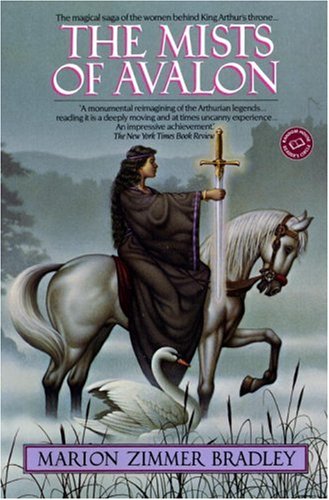
mists of avalon

I just finished The Mists of Avalon, by Marion Zimmer Bradley. I think it took me a month; this book is a monster. 876 pages in this Del Rey paperback fantasy from the 80s. This story definitely has some legs--it was made into a television movie with Anjelica Houston and Julianna Margulies in 2001--as it re-imagines the Arthur story from the point of view of the women in the story.

Bradley pulls the Lady of the Lake out of the water, and sets her on the ground, albeit, near the lake, and tells her story, as well as the stories of Gwenwyfar (Guinevere), Morgaine (Morgan le Fay), their sisters, mothers, daughters, and ladies in waiting. Arthur, Lancelot, Sir Gawaine, and the other knights of the round table are more like arm candy in this story, driven by not only their will to do what they feel is best for their newly emerging kingdom in England, but what they are driven to do by their love for, or obligations to, these strong willed and proud women.

Bradley takes many of her clues from historical facts, such as Druidism, and other early religions in the British isles, and popular theories of matriarchal societies in early Celtic traditions, to anchor the story more to reality, resulting in a book that reads more like historical fiction than the archetype mythical story of male-dominated chivalry. Throughout the narrative runs the thread of the struggle between the Roman Catholic Church (in the form of Bishop Patricus) and the Druidism and paganism of the time, which was being driven out, and with it: man's ability to access the Isle of Avalon. An island which exists and is as real as any other, but only to those who believe that it can. Avalon, like the religion it is home to, and the very goddess they worship, slowly fades into the mist as believers lose their faith in its reality. And isn't that what happens to all religions that lose its followers?

This one was fun, well thought out and done with a fresh viewpoint that I think anyone who is tired of the male-centric stories of this era would enjoy.

Monday, June 14, 2010

physik

My son and I just finished Septimus Heap Book 3: Physik, by Angie Sage. My daughter had told me she got a few books into the series and gave it up for lost, but after reading this one, I still feel that the story arc has some legs, so we'll probably read another.

Physik is a different branch of the mystical (or should I say Mystikal) sciences practiced by the wizards, and other learned people in this series, but one that in Septimus's time, is now looked down upon as so much potions and herb lore. Historically however, Physik was the powerful science of alchemists and other physicians. All of the main characters return in this installment, and many of the supporting charters, but some just in bit parts. This story also has some interesting twists that will pave the way for some fun stories in the future, but they aren't so outlandish that they seem forced.

We still had a laugh with the bold text and extra Es and Ys in all of the magical phrases. My son asked if I would pronounce them differently so he could enjoy them as much as I do when I'm reading. So will we keep reading? I think so. In the meantime, the fourth volume in the Nicolas Flamel series came out last month and we're reading that now. I don't know if I ever wrote about the third book in that series, The Sorceress, but it was good and we were waiting for this recent one to come out.