Leonardo and the Last Supper is my third or fourth Ross King book, I'm not really sure. One of them: Brunelleschi's Dome, you'll see down along the right hand column under 'great.' Leonardo won't be on the 'great' list. was that too abrupt?
Its been a while since I've read one of Ross King's books, pretty much everything I read now ends up on this blog and there aren't any of his books listed on 'the books' tab, so its a few years anyway. I also read one about Michelangelo and the Sistine Chapel ceiling, which was also very good. This latest installment wasn't up to those standards however, and I'm not sure why, but I have some guesses. In order for my guesses to be proven out, I'd have to go back and do a little comparative analysis, but that's not going to happen; this isn't science I'm doing over here.
Here's my guesses for what I think is missing from this book, when compared to the other two I mentioned. First, historical data. King seemed to be short on it, as is everyone else, and he did an admirable job in putting together this story from what seems like not very much. He had to rely quite a bit on other biographers, and then suggested that maybe those other biographers were wrong, or at least weren't above conjecture. Second, there isn't much to the story; da Vinci took a number of years to paint the Last Supper, but that seems to be because he was always busy doing something else. There isn't a whole lot of information about how the panting/mural was done, who worked on it, or what happened day-to-day. For that matter, there isn't much information available about what da Vinci was doing during this time either. So that brings me to my third point, the book is more filler than substance. Because so little is know about what the master was actually doing and how he did it, this book is more about what was going on in Italy at the time, centering mainly on his sponsor in Milano, Ludovico Maria Sforza, or as he was known, Ludovico il Moro (Ludwig the Moor.)
The Sforza story is a very interesting story, and I have a sneaking suspicion that Leonardo's name in the title was more about selling books than a true reflection of what this story is about. "Il Moro and Leonardo's Last Supper" might have been a better title given what I read. I'm not saying you shouldn't read this book, especially if you are a fan of Leonardo da Vinci, just don't expect that King uncovered some amazing treasure trove of lost information about him.
Last complaint: there are a handful of color plates in the center of the book, but no image of da Vinci's Last Supper. No where in the book, in fact, is there an image of the entire work.
book reviews, bookmark collection, discussions about libraries, library design, information technology... and robots.
Monday, May 12, 2014
leonardo, yeah, that one
Labels:
architecture,
art,
biography,
books,
history,
italy,
non-fiction,
reading,
science
Tuesday, May 6, 2014
song of the vikings
I'm guessing that Nancy Marie Brown, author of Song of the Vikings: Snorri and the Making of Norse Myths is an academic. I may be saying that because its mentioned somewhere in the front matter, or because the book is so well researched, including pages of end notes. But part of the reason I'm saying that is because this book reads like it was written by an academic. That's not a bad thing, and I certainly wouldn't expect a book like this to be written like a racy, historical fiction, it was just a little methodical, and occasionally repetitive. For example, I'm not surprised that I guy living 600 years ago died at the end of this book, and I didn't mind that it was foreshadowed in the text, but it may have been mentioned 2 or 3 times. I get it
Brown explains how she came to the story of Snorri through her love of Tolkien; the same connection is why I picked this book up after hearing about it on the radio. After reading Beowulf a little while ago, it became pretty clear that not only did Tolkien enjoy reading, studying and translating these old works, he borrowed from them too in his efforts to weave together a mythology for Britain. It was when I read Tolkien's translation of The Legend of Sigurd and Gudrún though, that I really understood his connection with Snorri Sturluson's work, and so when I heard about this book by Brown, I figured I had to give it a read.
This is Brown's biography of Snorri, and of Iceland. Its clear from the beginning that Brown is in love with Iceland, and that theme of exploring Iceland through Snorri, and Snorri through his life in Iceland is what carries the book. Snorri Sturluson may have singlehandedly saved the oral tradition of Norse myth for future generations, by writing down, and sometimes embellishing stories that had been told for hundreds of year, and maybe longer. He also inspired others in his own generation and in the generations that followed to continue the tradition.
This book was a lot of fun, and interesting to the Tolkien fan, but there weren't too many surprising moments, and only a few solid Tolkien tie-ins. What this isn't, is a translation of the Prose Edda, but what it is, is a great companion to go along with that, and a ringing tribute to the man that gave northern Europeans a mythology to rival the Romans and the Greeks.
Sunday, April 6, 2014
templar salvation
Templar Salvation is Raymond Khoury's follow-up to The Last Templar. There is a three year gap between the two story lines, but the two main character's pick up where they left off, pretty much, in their efforts to uncover the origins and the secrets of the Knights Templar. I've said it before in another Templar book review, there is a lot of traction left in the Templar myth, and they'll be writing stories about them for decades--if not millennia--to come.
In this book, Khoury addresses religion, all religion, but especially the three Abrahamic religions, and the impact the Knights Templar had on those religions, and he speculates on their relationship with the pope at a time when the pope decided that to be a good Christian you had to suit up, march off and start killing people for believing in a different version of God. And take over the holy land by force. Khoury's spin on how the Knights Templar gained control of the temple, and how they later became so rich and powerful make for an interesting read.
Khoury writes a good story, but its all pretty pat, so there aren't a whole lot of surprises in the story arc; the fun is in the backstory. I smell a triple!
Sunday, March 30, 2014
nerax at aeronaut
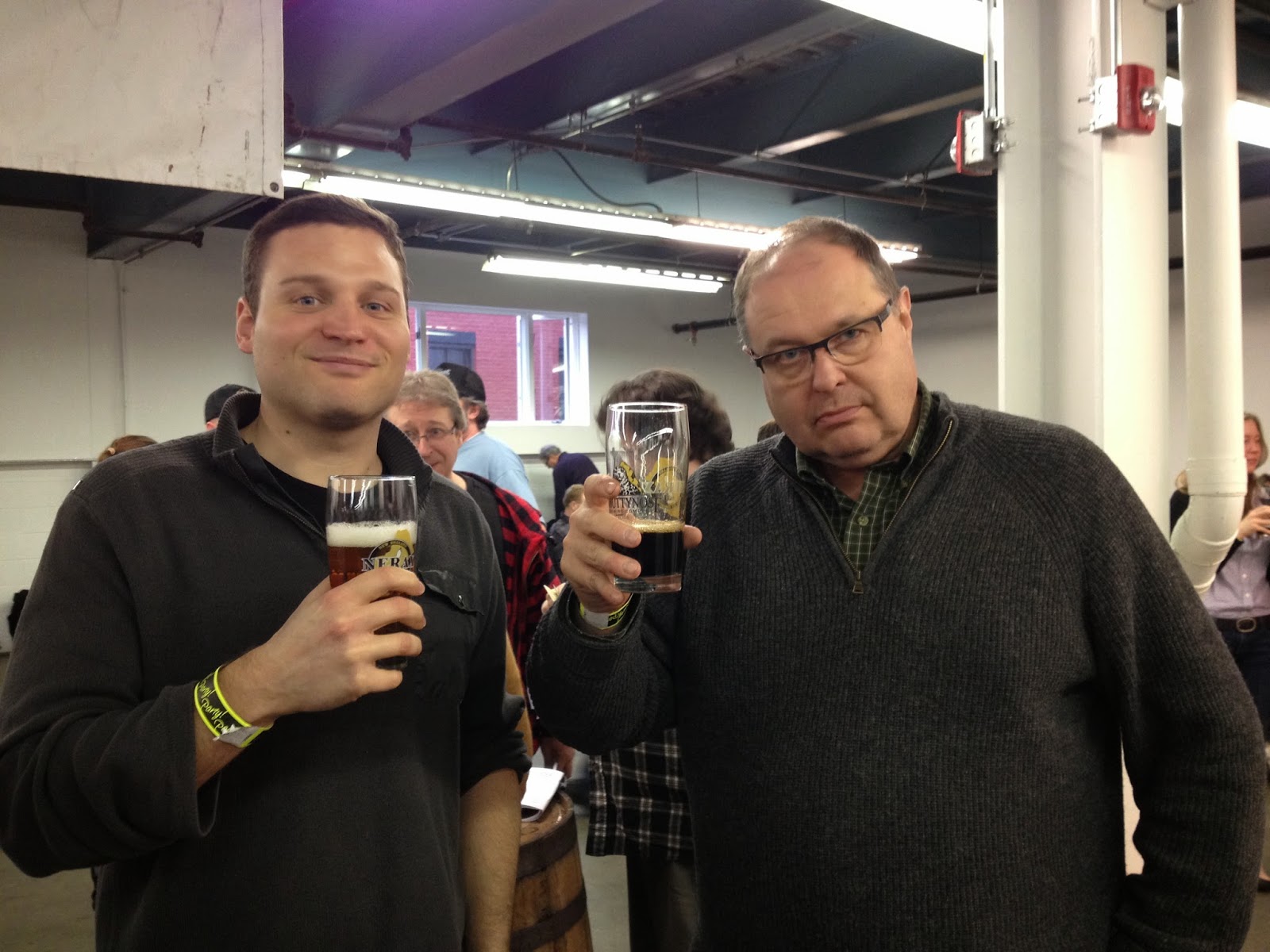
| Dan and Stew |
The guys and gals that run NERAX did another great job this year. The party started slowly on Friday, but by the time we had our fill and had to call it a night, the place was hopping. There were a lot of beers to try on Friday, and I went through the booklet they passed out while I was in line and made some marks next to ones I wanted to try. Sadly, a lot of those were gone, including BOTH Aeronaut offerings. I also noticed that on the American side, most of the casks came from the east coast--I saw one from California. They also had two casks from Germany this year. I found plenty to tickle the taste buds; here what I tried:
Dark Age - Celtic Experience, Caerphilly, Wales (ABV 4.2%)
This dark ale was listed as mild, which must be a UK description, but it seemed apt. Thin, medium brown with a very light, foamy head. Sour mash nose. Dry and bitter with a slight Belgian basement tang, long bitter finish with chocolate, pith, yeast and leather notes. The clean, bitter taste hangs in the mouth until the next sip. A great way to start the night.
Duncan's IPA - Inveralmond Brewery, Perth, Perthshire, Scotland (ABV 4.4%)
This is one I put two stars on while waiting in line, and they had it. Beautiful, clear sunny gold color with an airy, bubbly head, that lasted until the last sip. Fresh caramel malt on the nose, with light bread and vegetable notes. Clean, dry and bitter with a pleasant pithy aftertaste. Dense hops profile, but quietly done. Nice.
![]() |
| Duncan's IPA quarter pint pour |
Monk's Christkindl - Klosterbrauerei Weissenohe, Weissenohe, Germany (ABV 6.5%)
Malty, fruity and sweet smelling. Hazelnut brown, medium bodied boch, slightly cloudy with just the faintest skuds of suds on the surface and a few bubbles at the edge of the glass. Fruit cake, cherries, mollasses, and B&M Brown Bread! really on the nose. The body cleared as it rested. Burnt sugar, spice, Amaro, and bitter roots; super complex in the mouth. There is a bitter, sharpness just beyond the complexity that keeps this delicious holiday beer from being too sweet, but I couldn't figure it out.
Midnight - Monty's Brewery, Powys, Wales (ABV 4.0%)
This black-brown stout is rich with a creamy but thin head. Clean and light mouth feel, watery and deep. Dry, sticky, soft, almost powdery finish. Light smoke and espresso at the end.
Sunlander - Stonehouse, Oswestry, Shropshire, England (ABV 3.7%)
Pale yellow, bright and clear with a feathery, pale yellow head. Grapefruit citrus on teh nose. Sharp citrus attack, clean, bright hops and summery finish. Additional sips brought a coppery metallic taste. You know that flavor when you take a sip from a drinking fountain in a place you've never been, and discover that no one's used it in six months. Yeah, that; but in a good way. DOn't get the wrong idea, this beer was great.
Then there's this Twitter pic that NERAX had posted on their Facebook page. Yeah, that's me in the foreground, with the backs those two guys I was with. Their faces appear in the pic at the top of this post.
Looking back, I see that with all of the local beers, I stuck with Europe this year. Lots of the American beers I had flagged were kicked. See you next year!
Sadly, there is no 2013 post. I was sick.
Click here for my NERAX 2012 post
Click here for my NERAX 2011 post
Click here for my NERAX 2010 post
last templar
My wife gave me The Last Templar just after she read it, saying it was pretty good. I think that's a fair summary. I've read a couple of books by Raymond Khoury, and he can write a good story. Shortly thereafter, my wife asked me to have a look for the follow up to this one at the library, which I did, and they had, so I got it for her. I'll read that next, before it goes back.
I had just recently read Steve Berry's Templar book a few years ago when I first saw this book, but needed a break from the Templars, and then forgot about it. Ah... the Templar, they just keep on giving. Who doesn't love a bunch of guys who join a monastic order, take a vow of poverty, strap on some armor and go defend the holy land, and get filthy rich doing it, regardless of their poverty vow. Who knows. But then the Vatican became a war state there for a while, too. Maybe it was just a fad, you know how these young religious boys get.
Anyway, Khoury gives a little tease about what the Templars may have discovered during their time in the holy land, and how one of these treasures may have been lost. Fast forward to now, and the opportunity presents itself for this lost treasure to be found, and mayhem shortly ensues. Khoury puts together a tag team of foxy academic who can't help solving clues 'cause she's wicked smaht, and Doogood Supercop, who just wants to solve crime and make the word a better place, and so grudgingly accepts the help of the academic. I won't spoil it for you...
Khoury does a good job of dreaming up some interesting pitfalls for our duo, and the story chugs right along. I'm not saying that he going to win the Nobel prize here, we all know how this is going to end, we've read it before, but that's why we read these books. Its like watching a weekly TV show. You worry about the main characters when they're in trouble right before the commercial break, but as my mom said, when we were especially worried about The Six Million Dollar Man one night, "Don't worry, he'll be fine." And when we turned to her, our faces full of questioning awe, she followed up with, "He has to be, he's on again next week." << pop! >>
This was a fun read, and I'm going to bang out the follow up before getting to the others on my list.
Tuesday, March 18, 2014
second foundation
Second Foundation is the third and last of the original Foundation Novels trilogy by Issac Asimov. Asimov later rebooted the series and added four more books in the 80s. Based on my experience with the first three, I'll end up looking those up at some point, but I think I'll take a break for a while and dig into something else. I actually have a few interesting books on deck
Second Foundation follows the loooooooong story arc instituted in the first book and continued in the second. Asimov visits the story every few generations to see how its progressing, and I can see why he eventually came back to it: of the 1000 year span he gave the story, the first three books chronicle about 400 years. So I guess there's more story to the story.
As the title implies, this installment centers on the second foundation, established at the beginning of the 1000 year story arc by its architect, Hari Seldon. I'm not a fan of spoilers, so I won't say more, but what I can tell you as that this set of stories is just as good as the first two, and it does help to fill in some of the blanks left by the earlier tales. It does not, however, resolve the story, as I mentioned above. One would assume that Asimov got to that in the four subsequent books, altho one of those is a prequel to the first book. I guess its fair to assume that there is a second trilogy and the prequel; that seems neat enough.
Sunday, March 16, 2014
foundation and empire
Its been a while; I read the first in the Foundation series back in 2011. Foundation and Empire is the second in the original trilogy, which many credit for creating the boom in space-based science fiction since then. Isaac Asimov wrote Foundation while he was in his early thirties, in 1951, and the follow-ups came in the years after, 1952 and 53, but Asimov returned to Foundation for additional volumes in the 80s, eventually expanding the franchise to seven novels. These additional 4 books are sometimes referred to as the Extended Foundation novels. On a somewhat related note, I also read a short story by Orson Scott Card a while ago, which riffed on the Foundation series.
The Foundation series is interesting if only due to its vastness. The story arc encompasses the entire galaxy, thousands (millions?) of worlds, hundreds of characters, and a thousand years; all on the same story arc. worth repeating, I thought Asimov decided to look at the galaxy-wide implications of a single idea: Foundation, as it ripples throughout the entire inhabited galaxy, over the course of a thousand years. Mind boggling in scope. But the very idea of Foundation is so interesting, that it drives the story, generation after generation, from planetary system to system.
Looking back at this classic tale now, I'm struck by the things that Asimov imagined, and others that he didn't. He does make the point that over such huge expanses, such as the galaxy, and the time periods we're talking about--a future so far distant that man has populated the entire galaxy, so far in the future that there is no memory, no extant record even, of where man originated--that things necessarily change. So I guess I can see that its possible for some things to have changed dramatically, or even to have gone through cycles, but even Asimov wasn't brave enough to write a story where women are equal to men for his 1951 audience.
Some other things Asimov foresaw: tobacco would be propagated out into the ether, and still widely utilized, space ships and ground cars run on 'nuclear' fuel, printed newspapers are still in daily use, private messages are physically sent in little, hard-to-open canisters, well-to-do middle class folks have servants in their households, and when a woman in the room gives her opinion, the men are surprised, a little amused, but do (thankfully) take her seriously and don't throw her out.
Enough about the 50s, Foundation, for all of its dated-ness, is a great story, or maybe more accurately, its a series of linked and related short stories. Foundation and Empire follows on in a chronological pattern from Foundation, tracing the history of this galactic millennium and chronicling the challenges to Hari Seldon's plan. I'm looking forward to the final book, Second Foundation.
Sunday, March 2, 2014
silas marner
Silas Marner is one of those books I saw the smart kids carrying in high school, and the journalism kids carrying in college, but I never got around to it. I found copy a few years ago in McIntyre and Moore, Booksellers, in Davis Square, so I guess its been a while; they're gone now. The copy I bought is a pretty little hardcover, clothbound in bright blue buckram, with a blue burnished top, and gray and white endpapers decorated with the publisher's (Collins) logo, two back-to-back, linked "c"s, set in a diamond grid. Looks a lot like the Chanel logo, if you ask me, but it probably predates it. The book jacket is almost perfect. click on the cover for a blow up
This copy also has an interesting provenance: it was printed in the UK by Collins,* of London and Glasgow, in 1970, as part of their Collins Classics, and is numbered on the spine as 523, and then purchased in South Australia, according to a sticker placed on the inside cover, which reads:
There is a half title page, which includes an etching of the author on the verso, and a handwritten dedication on the recto, in French, which reads:
Which I've translated as:
Assuming the book was purchased in Adelaide, and mailed out from Canberra, a two hour flight, or 11 hour drive from Adelaide, I assume our Miss Joukovsky was traveling in the southern part of Australia and mailed this to two young girls (sisters?) here in the States, or maybe Canada?
So how was the read? Silas Marner was pretty good. There are a few other, shorter stories in this volume, and few poems. The other short stories reminded me of Henry James, particularly; The Turn of the Screw, and Daisy Miller: A Study. Its not that those short stories were similar in plot, its more a similarity of subject matter and writing style. Both The Turn of the Screw and The Lifted Veil deal with vaguely occultist matter, and both Daisy Miller and Brother Jacob are studies of a particular character.
George Elliot--a pseudonym for Miriam Evans--is a very careful writer, and pays close attention to the writing and character development. It doesn't seem as if the plot is the driver in her stories, its the writing. A similarity she also seems to share with James.
Silas Marner: The Weaver of Ravelow is about 175 pages, and it is a study of a bachelor who is torn from the place he knows and transplanted in a new place: Ravelow. Elliot then studies what happens to him as various things befall him, and writes about the results. This is also true with the supporting characters, and even some of the minor characters. Elliot seems very interested in what makes people tick, and examines it in her writing.
* I assume this is William Collins and Sons, acquired by HarperCollins, who still prints Collins Classics under the name New Collins Classics.
This copy also has an interesting provenance: it was printed in the UK by Collins,* of London and Glasgow, in 1970, as part of their Collins Classics, and is numbered on the spine as 523, and then purchased in South Australia, according to a sticker placed on the inside cover, which reads:
BECK BOOK CO. PTY. LTD.
New and Secondhand Booksellers
53 PULTENEY STREET,
ADELAIDE, S.A. 5000.
There is a half title page, which includes an etching of the author on the verso, and a handwritten dedication on the recto, in French, which reads:
A mes petites amies Ariane et Daphnaé avec mes meilleurs voeux et gros baisers. Canberra, 1976, Tania Joukovsky
Which I've translated as:
To my little friends Ariane and Daphnae with my best wishes and big kisses. Canberra, 1976, Tania Joukovsky
Assuming the book was purchased in Adelaide, and mailed out from Canberra, a two hour flight, or 11 hour drive from Adelaide, I assume our Miss Joukovsky was traveling in the southern part of Australia and mailed this to two young girls (sisters?) here in the States, or maybe Canada?
So how was the read? Silas Marner was pretty good. There are a few other, shorter stories in this volume, and few poems. The other short stories reminded me of Henry James, particularly; The Turn of the Screw, and Daisy Miller: A Study. Its not that those short stories were similar in plot, its more a similarity of subject matter and writing style. Both The Turn of the Screw and The Lifted Veil deal with vaguely occultist matter, and both Daisy Miller and Brother Jacob are studies of a particular character.
George Elliot--a pseudonym for Miriam Evans--is a very careful writer, and pays close attention to the writing and character development. It doesn't seem as if the plot is the driver in her stories, its the writing. A similarity she also seems to share with James.
Silas Marner: The Weaver of Ravelow is about 175 pages, and it is a study of a bachelor who is torn from the place he knows and transplanted in a new place: Ravelow. Elliot then studies what happens to him as various things befall him, and writes about the results. This is also true with the supporting characters, and even some of the minor characters. Elliot seems very interested in what makes people tick, and examines it in her writing.
* I assume this is William Collins and Sons, acquired by HarperCollins, who still prints Collins Classics under the name New Collins Classics.
in like a polar vortex lion
Iiiiits Maarch!
If you been around here for a while, you know I do this every year. This year it seems even more important; we learned what a 'polar vortex' is this year, and the polar vortex doesn't want us to forget.
photo of the lion at Boston Public Library, by Michael Burton, used without permission.
This is my March hypothesis: If March comes in like a lion and goes out like a lamb, the other days must also have animality. So we need a scale, so you can see how lionish or lambish we are on a particular day. This is information you can use to plan your day: decide what you'll wear, how to get to work or school, whether you'll need a rain slicker, or a cattle prod. You know, the basics. I envision people using this information the way they might check in with the weather channel, like this:
"Honey, what's today?"
"Scorpion."
"I'll wear my wooden shoes." maybe I should create an iphone app. yeeaaah, I can give it away and be rich!
Here's how it stacks up. yes, its the same every year, that's why we call it a tradition.
March 1 - Lion: This one's a given. March 1st will tear you up.
March 2 - Tiger: Up to 11-feet, and nearly 700 pounds!
March 3 - Bear: Oh my! Black, Brown, Polar, you never know.
March 4 - Shark: Just remember Jaws 4.
March 5 - Wolf: Big. Bad.
March 6 - Bull: One word: Pamplona.
March 7 - Moose: Brake for moose, it could save your life.
March 8 - Eagle: Don't leave your pets outside... or your children.
March 9 - Scorpion: Step on it before it steps on you.
March 10 - Dingo: No, its not a stray dog.
March 11 - Hawk: Swooping, screaming, death on wings. If you're a vole.
March 12 - Lynx: They're adorable... when observed from Florida.
March 13 - Bat: If you just get near one its a full rabies series. In your belly.
March 14 - Monkey: It could cackle and scratch, or cackle... and then scratch! HBD Coleen!
March 15 - Snake: The Ides of March. Snakes are known for wisdom, and treachery.
March 16 - Ox: Hard working in a plodding kind of way.
March 17 - Elephant: Wise, big, powerful... gray.
March 18 - Raven: Nevermore.
March 19 - Stag: Power and compassion. Might make a good patronus.
March 20 - Crab: This one can sneak up on you. First day of spring!
March 21 - Goat: Stubborn and tough going.
March 22 - Horse: Strong and reliable.
March 23 - Pig: Smart but messy; wear your boots today.
March 24 - Dog: Friendly and good-natured; take a walk.
March 25 - Dolphin: Fun and wet; bring an umbrella.
March 26 - Rooster: Proud strutter. Crow at the sun!
March 27 - Turtle: Muddy, but adorable; boots again.
March 28 - Toad: Are they greenish-brown, or brownish-green?
March 29 - Robin: These guys are out when the worms show.
March 30 - Rabbit: How can you be scared of rabbits? HBD Kelton!
March 31 - Lamb: Mmm... arrosticini. Smells like spring!
According to one source I read "This phrase has its origins with the constellations Leo, the Lion, and Aries, the ram or lamb. It has to do with the relative positions of these constellations in the sky at the beginning and end of the month." Yeah, Aries, the lamb, that must be it. Somebody is thinking too hard. I think the origins of something like this are pretty self-evident.
Today certainly was a lion. It was a frozen, cold, windy lion. With dirty snow banks, and muscle cramps from 3 months of shivering. I think the same snow has been in my yard since Christmas.
Let's see how we do this year! Come oooon, lamb!
Subscribe to:
Posts (Atom)