Showing posts with label english. Show all posts

Sunday, May 17, 2026

lying game


The Lying Game is by Ruth Ware, and English author who brought us The Woman in Cabin 10. I saw this book at my library's book sale and because I thought the Cabin book was good I picked this one up.

The book cover, which is similar to the illustration shown here,* also notes that this book was featured in a book club with Reese Witherspoon's name on it. I'm not sure what that means, I didn't know she had one, and this book is from 2017, although the paperback was probably printed a year or so later, and I'm not sure if Witherspoon still has a book club or not. Looks like she does and it looks like the club features books by women authors, so good on you Reece.

Not only is this book written by a woman, it focuses on the story of four women, that have know each other since their high school days at a boarding school near the coast, not too far from London. The story is about friendship, secrets, and lies, and how they shapes the young women in the story into the adults they become, and what it means when part of their youth, that they may have been hoping would stay in their past, catches up with them.

Its tightly written, with tension, mystery, and an interesting look at the things we share, and the things we don't. Ware did a pretty good job with this one too.


* Mine looks like this; the badging is different. 


Saturday, May 9, 2026

eye of the needle

Eye of the Needle is a Ken Follett World War II novel from 1978. I picked this up from the book sale at the Bigelow Free Public Library in Clinton, MA. The Bigelow is a pretty little library built with Guastavino vaults about 100 years ago. It was built with funding from the Andrew Carnegie Foundation, and opened in 1902. The library director gave me the thumbs up on this book, and altho I've read Follett's cathedral stories, I haven't read any of his spy thriller work (or maybe anything else he's written?)

Anyhoo, this is a well paced, inspired by reality kind of thriller, and it certainly checked off all the boxes for me. It was exciting, believable, seemingly well researched, tense, and in some cases brutal, and in other cases sad, and still others, sweet. The story is set mainly in the UK, toward the end of WWII, with glimpses of what was happening in Germany at the time, or at least what Follett speculated could have happened based on the information we do have, both about the events in the UK and Germany. He comes right out and says up front that we all know the results, but it was close there for a while, and while we don't know all the details something like this could have happened. I'm paraphrasing. because I didn't want to get up and get the book

 Its crazy to imagine that in 1978, the world was much closer to the end of WWII, than we are now to 1978. Follet wrote this just 30 or so years after the end of the war, and its getting close to 50 years since he wrote it. The story holds up however, probably because its set in an earlier period and it seems that Follet was careful to avoid modern terms and lingo in his writing (at lest to my eye.) This is James Bond without the tuxedos. Its gritty, and the story is wrapped up in everyday life, and the struggles of people living through a war, and doing the best they can in crummy circumstances.

Saturday, May 2, 2026

dombey and son

Dombey and Son is not a book I’d heard of before. It was written by Charles Dickens beginning in 1846, and published as a serial, with pamphlet size installments issued once per month for 19 months between 1846 and 1848 by Bradbury & Evans, with illustrations Henry Clarence Pitz. Shortly after the last (double-issue) pamphlet was released, the entire book was published in hardback. Serialized books read differently than other books, in my mind anyway, as they can be had in one go without having to wait. And because one had to wait, there could be cliffhangers at the end of a monthly installment; but there also needs to be a way to make sure your readers will remember where they are in the story, and who the characters are. This is why, I believe, the characters are almost caricatures, or archetypes, which makes their personalities so striking, especially when contrasted to other characters in the story. The character names are also a clue, and consequently can be very amusing. One can imagine that a gruff imposing landlady named Mrs. MacStinger, should not be crossed without some consequence.

Reading a serialized novel is similar to spamming a television series that was designed to be broadcast once per week. The regular pacing of a weekly TV show, its alignment with holidays, and the passing of seasons, felt in many ways that you were following these characters along in their lives at the same pace you were living along with them. While Dombey and Son takes place over a longer story arc than the 19 months in which it was originally published, I’m sure that span of time helped with the pacing as the story stretched through the years. Reading it all in one volume is the 1840s equivalent of the spamming.


I picked up this volume at the book sale in my local library. It had no book jacket, although I assume it probably did,* and there was a small leaflet tucked inside the front cover which I thought was a found bookmark. Because I didn’t know about it, and had no book jacket to consult, I read the first line and I was sold. Between that first line, and the handsome binding, it was clearly worth the $2.00 I paid for it. After getting it home, I found that it is a Heritage Club edition. The Heritage Club published books with quality bindings, using their own editing staff, illustrators, and bindery, and made them available at an affordable price to their members. The leaflet tucked into the front is a small newsletter to the club members called  "Sandglass" that discusses the book, the printing, and Dickens himself.


The original title was Dealings with the Firm of Dombey and Son: Wholesale, Retail and for Exportation. yeah, glad they shortened that up It’s a big book but I really enjoyed it. I can’t say that I couldn’t put it down but I did find myself picking it up more often that my usual reading times at breakfast and before bed. Not only that, Dickens had me emotionally tied up with these characters. It may be because of the serial format, or it may just be a literary tool, but the characters had such clear personalities that you could almost guess what they might do, and when wrong, it was either much worse or much better, depending on the character, than you may have guessed.


There are some familiar themes here that Dickens is examining. Themes that we’ve seen him mull over before in books like A Christmas Carol, and David Copperfield. Paul Dombey could be compared to Ebenezer Scrooge, and James Carker would give Uriah Heep a run for his money. What I especially liked is how Dickens examined insidiousness in his evil characters. They aren’t as smarmy or blatantly vile as they are in more modern stories; Dickens’ baddies use the very etiquette of a polite and civil society, especially the higher class norms, as the pool in which he has these creatures wriggle about like eels or prowl like sharks, outwardly smiling and nodding as they watch their prey twist in agony. By contrast, Dickens’ good characters are personifications of the divine upon the earthly plane. It doesn’t matter what happens to them, how terrible their misfortunes, how bleak their outlook may be, they smile or simply tighten their belts, and push on, with endless reservoirs of love, kindness, understanding, and forgiveness. Maybe that’s putting too fine a point on it, and perhaps it’s a bit of a spoiler, but if you’ve read Dickens, I don’t think this will come as a surprise.


I really enjoyed this one, and I can imagine reading it again at some point to see if it still holds up, like I’ve done with similar books, like The Count of Monte Cristo. After a quick look online, it seems as though Dombey and Son is not unknown in the UK; I found many different adaptations of the novel in British movies and television programs


Read this book. Maybe twice!


* After writing this, I discovered the Heritage Club edition came in a red slipcase as shown in the photo. This wasn't there at the library box sale, where I got mine.


Wednesday, April 29, 2026

murder room

The Murder Room is an Adam Dalgliesh mystery novel by P. D. James. This isn't the first of her mysteries I've read, and they've all been headed by Commander Adam Dalgliesh. This popular figure has apparently inspired a British TV series called "Dalgliesh", which appears to have begun at some point between the time of my last read of one of his stories, and the time previous. clear as mud

The Murder Room sounds like an archetype murder mystery where everyone is locked in a room, and someone gets killed, but that is not the case here. James takes her time with the first few chapters introducing the cast of characters, which gets a little dry, frankly. while I'm waiting to get to the fun, frigging, part of the game Once we got into the thick of it, the story moved right along for me. 

Altho the characters were saying to one another that it was all pretty clear to them, I only had some suspicions, but not enough for it to be clear to me, but then I'm not a big mystery reader, or a detective, so it was interesting to read the whodunit part.

This was another great installment in the Dalgliesh series and you can see why they've done a TV show, which may still be running in the UK. If you're a mystery fan, especially a British mystery fan--yep, they read differently--then look up P.D. James.


Sunday, July 14, 2024

body in the fjord

The Body in the Fjord is an installment in the Faith Fairchild mystery series, by Katherine Hall Page. Number 8 of 26, according to the Amazon description. I haven't read any of the others, I picked this book up, along with a handful of others I've read recently, at a library book sale in Dracut, Massachusetts. I haven't written about my reading recently as I've been absorbed in other things that have eaten up some of my spare time.

This mystery doesn't feature Faith Fairchild much, but rather, her employee, Pix Miller, who works with her at the catering business Faith Fairchild runs in the fictional town of Aleford, Massachusetts. Pix's mother, Ursala Rowe, who emigrated to America from Norway, is contacted by an old fried who is missing her granddaughter, Kari. Pix promptly flies off with her mother to Norway, and books passage on the tour of Norway's fjords by cruise ship, where Ursula's friends granddaughter was working when she disappeared, and which is apparently still underway, notwithstanding  a death of one employee and a missing second.

They quickly learn that Kari's fiance was killed in a tragic accident--he fell into a waterfall and was drowned in the fjord below--and Kari hasn't been seen since. 

Pix and her mother Ursula discover all kinds of interesting facts, altho its unclear if any have anything to do with the missing woman. Other people die, swastikas are lit on lawns, the other tour passengers are an odd group, and each of the mother and daughter team attempt to learn more about each of their fellow travelers in order to uncover the mystery of the woman's disappearance.

After a very set of adventures, and meals of interesting, traditional Norwegian food (recipes included) they eventually solve the mystery, altho I'm not sure exactly how. They seems to just stumble upon it, along with a another criminal enterprise, which they also help to put an end to.

This was a funny little story, but I can see how the quaintness of the travel, and the food, including recipes at the back of the book, can be fun for the right audience, and someone clearly buying Katherine Hall Page's books. I just think I will be one of those, based on this read.


Saturday, November 18, 2023

gawain and the green knight

Sir Gawain and the Green Knight, Pearl & Sir Orfeo are three poems translated from Middle English by J.R.R. Tolkien. The first two were discovered contained in the same manuscript, along with two other poems, written in the same hand, around the year 1400, according to the introduction, edited by Christopher Tolkien from a number of sources which original with his father, including notes, transcripts from broadcast interviews, etc. Sir Orfeo is contained in three extant manuscripts, and the one Tolkien used is dated to the 1330s, inscribed, probably in London. The original authors are unknown.

Tolkien worked on the translations a number of times from the1920s up through at lest the 1950s according to the preface by Christopher Tolkien, and in some case in collaboration with other experts in the field. In some cases, Christopher found multiple versions, and made an effort to use the most recent updated forms for this publication. The copyright is dated 1975 and held by Tolkien's long time publisher, George Allen & Unwin, Ltd. and published in 1980 by Ballantine Books, of New York.

The trickiest part of the translations, according to the front matter, is the rhythm, not the strict iambic metrical foot used in other forms, such as Shakespeare, but a more loose rhythm of stressed and less stressed syllables, more closely matching natural speech, combined with alliterative sounds within many of the lines, such as this example given in the Appendix (also credited to J.R.R. Tolkien, and edited by Christopher):

Tirius went to Tuscany         and towns founded*

In this line, I've bolded the stressed syllables in red, and obviously, Tirius, Tuscany and Towns alliterate. I've added the break in the line, as the example in the aforementioned appendix did, to illustrate that each line is composed of two chunks, according to Tolkien.

The trick is apparently finding the words in moderns English that both tell the same story, give the same intended meaning, maintain the meter and rhythm, and don't damage the structure of the poem or its speech patterns so much that it is no longer a worthy representation of the original.

Sir Gawain and the Green Knight is the longest poem, at about 80 pages, Pearl is about 33 pages, and Sir Orfeo is shortest at about 15 pages. Each seems designed to be spoken aloud, as one assumes that not many in the 1300s and 1400s could read, and they each seems to be focused on a story that is both exciting, and includes lessons on life and strong moral. They each extol the glory of God and being good, and the rewards that come from keeping both of those aspirations close at heart. Each also has a sprinkling of magic, often dressed as dream or phantasm brought on by sleep, drink, or love. All of the ingredients for that which Tolkien was trying to restore to England, its lost native mythology, which he imagined was as rich and diverse as the Greek, Roman, Egyptian, or any other ancient civilization that didn't suffer the losses brought on by England's northern, damp climate, which is so hostile to things like old parchment manuscripts.

What I found most fun was the similarities in some of the themes from the adventures themselves that were clearly the inspirations,** at least in part, for some of Tolkien's fiction. That itself, is worth the price of admission.


* Sir Gawain, stanza 1 

** Tolkien fans out there will have heard the comparisons between The Lord of the Rings and Wagner's Ring Cycle (Der Ring des Nibelungen) which Tolkien denied, and still many try to say that it is at least partially inspired by Wagner, regardless of the author's dismissal. But Wagner was himself inspired by an old Middle High German poem from around 1200, called Nibelungenlied (The Song of the Nibelungs), which is in turn, based on oral traditions that likely go back to Old Norse sources, which Tolkien did study. In his 2011 essay on this comparison, Jamie McGregor provides a quote from Tom Shippey's work on Tolkien, indicating that Tolkien has a distinct dislike for Wagner (and other authors, including Shakespeare) and felt that they "had got something very important, not quite right." That, to me, explains why the similarities are present, i.e., they used the same source material, but Tolkien's inspiration, and what he took from the texts and traditions he studied, could be his own.***

*** One of Tolkien's friends--and a member of the Inklings, which they founded with their literary friends--C.S. Lewis, was described by Roberts Giddings, again, according to McGregor's essay, noted above, as a "rabid Wagnerite" and in his mind the source of the Wagner "taint" in Tolkien's work. Not having read Giddings work myself, I can't tell you if that theory is supported by any evidence, but in absence of that, I'll only add that it may be that Lewis saw these associations himself, and may have even brought them up to Tolkien himself, and if he did, I assume that Tolkien's response was the same to Lewis as it was to more public comparisons, altho, I also assume, perhaps more pointed.


Saturday, July 15, 2023

amina al-sarifi adventures

I was first attracted to this book at the library. It was on the shelf, face out, in the new fiction section, not far from where I had recently found The Priory of the Orange Tree, and then The Day of Fallen Night, both by Samantha Shannon. The Adventures of Amina Al-Sirafi is by Shannon Chakraborty,* so there is a similarity in the names, but not just that, the illustrations on all three of these books seemed similar, so I picked up Al-Sirafi thinking that it was another book by the same author.

Similar name (Shannon)... similar artwork... but no, this is a different adventure. One I turned out to like, but the similarity in the illustrations was uncanny. I figured that it had to be the same person.

Yep.

Ivan Belikov did the cover art for all three of these books. Belikov does these rich, crisp illustrations of mystical beasts that made him a great choice for all three of these adventures.

The Adventures of Amina Al-Sirafi is the first (I'm assuming) in a new series of adventures for Shannon Chakraborty. I haven't read her stuff before that I can recall, but she established herself with another fantasy series known as the Daevabad Trilogy. I say the first in a series, but this actually read like the first book is a series, which has also intentionally left plenty of room for prequels, if this series does well. I guess you might call that savvy.

This story does--perhaps because of the need to leave room in both the future and the past--spend some time and text on both world building and backstory, but the adventure makes up for that, especially when one considers that there is probably more to come, and that backstory is going to be helpful in the future. and the past? the future-past? past-of-the-future? 

Chakraborty is a fan of history, according to he acknowledgments, and did lots of research to ensure that the travels, the ports, the seas, the ships, and the customs, Amina Al-Sarifi is awash in ring true. There is even a bibliography and further reading suggestions at the back of the book, including some translations of a few of the adventures this stories Al-Sarafi is based on. Most of Chakraborty's research was done in the original language, and she points out that there aren't many of those volumes that have been translated into English, so she has us (sole English speakers) at an advantage there. 

Does this book remind me of The Story of Sinbad the Sailor? Yep. Is that a bad thing? Nope. This one is worth a read, and I'll be looking for the next one.


* Shannon Chakraborty used to use the "author name" S.A. Chakraborty, which she used for the Daevabad Trilogy. Looks like Shannon Chakraborty is the name her future works will be published under.

Sunday, August 14, 2022

sweet tooth

To prepare for this review of Ian McEwan's Sweet Tooth--NOT to be confused with the book that inspired the Netflix show of the same name--I was looking for a cover shot, and another cover showed up that was very familiar. I wasn't searching for another book by McEwan, but maybe I picked this book up at the same library book sale. Maybe they were donated by the same fan. Who knows?

Sweet Tooth is the name of an operation, undertaken by the British secret service, and our protagonist is just getting her feet under her, learning the ropes at her new job, when she is tapped, along with a group of other new young women, to take on this task. Seems pretty thankless; a kind of late, cold war, down-with-communism effort that doesn't seem like it has the potential to win many hearts and minds.

The overall pace of this novel is a little slow, and the stakes aren't especially high. This isn't a James Bond story. I actually got to within about a hundred pages from the end, and I put it down to take a break and read something else. I don't do that often, so yeah, pretty slow. But I'll tell you, when I picked it back up, I was glad I did. The last hundred pages or so were not what I was expecting, and the book ended up being better than I thought it would be. 

I'm a pretty slow reader, and I usually read in short spurts (at breakfast, before going to sleep, maybe 20 minutes at a time) so it takes me a few weeks to pound through a book. If you're a fast reader, then this probably won't be a problem and I can recommend it as a pretty good read. If you are a slower reader, this one might be okay if you have a little more time on your hands, and don't necessarily need a book that keeps you rapt. Like, maybe you're going to the beach, but you also have to keep an eye on the kids, so they don't get swept into the ocean.

Sunday, June 19, 2022

original sin

I've read a few books by PD James now, and this one ranks up there with the others. there may be only two others yep, that's what I found* PD James is again writing here about her favorite detective, Adam Dalgliesh. Dalgliesh was also the man of choice in both of the other books I read as well. Dalgliesh is a solid character, and he does tend to get his man, but there wasn't so much dectectiving in this one as much as there was an unraveling of the plot by the murderer. Don't get me wrong, Dalgliesh and his team did plenty of good detective work, they just didn't really need it in the end. Unless you consider that perhaps all their hard work is what caused the failure of the murderer to conceal their tracks in the end.

James spins a tight yarn. Original Sin was written in 1994. The other two I read, The Black Tower is 1975, and Devices and Desires, is 1989. So this one is more recent; is this book, near the end of her career, less captivating than her early work, or does it show the polish of decades of writing? I don't know, I haven't read enough of her work to be able to answer that question. I can tell you that, like the other two, this was a slower read, but still fun and entertaining. I didn't read it instead of other things, as I sometimes do with great books.

PD James died in 2014 at 94. According to her website, there are 13 Adam Dalgliesh novels, and a bunch of other stuff she's written. Her website seems to be missing the last one in the series The Private Patient (making it 14 Dalgliesh** books.)


* That's two others that I have read. Now, is it possible that I read another P.D. James book before I started this blog? Sure, but I doubt it. I heard about James on a summer reading piece on the local public radio station a number of years ago, and I thought she might be something my wife would like. 

She didn't.

**  The Adam Dalgliesh character has appeared on television in the UK a fair amount it seems. Baroness. James was, and continues to be it seems, a very well known writer in the UK, and folks seem to enjoy the Dalgliesh character; there was a number of episodes of Masterpiece Mystery, featuring Dalgliesh, which began in the 80s and ran for years, a number of television movies , and there is currently a new TV show, on since last season.


Sunday, November 14, 2021

devices and desires

Devices and Desires was written by PD James in 1989; I read the first Vintage Books edition, printed in May 2004. The front matter includes information about PD James, indicating that she authored 20 other books, many about Commander Adam Dalgliesh who appears in this one. James won a number of awards including being named Baroness James of Holland Park in 1991. James died in 2014. I think I’ve read something else by James, and after a quick look I find that I read The Black Tower in 2011.

Adam Dalgliesh is visiting the (imaginary) Headlands on the north-east coast of Norfolk. In an authors note PD James adds that “Lovers of this remote and fascinating part of East Anglia will place it between Cromer and Great Yarmouth.”

D & D has a pretty big cast of characters, and James does her job giving us a reason that just about anyone of these characters could have done the deed, leaving us guessing until the end. Now, if you were an avid reader, and were really motivated to figure out whodunit before the end, I guess there may be enough information given for you to figure it out, but I' not that guy. I'm the guy that lets the author do their thing and tell me a story. Trying to figure it out, like a puzzle, is someone else's job, I'm here to be entertained. I was.

This was a slow read, which tells me I wasn't on the edge of my seat, dying to know what happens next. That doesn't mean I didn't have a good time. I'll keep my eye out for other PD James books, I just won't run out and buy everything she's ever written tomorrow.

Tuesday, June 27, 2017

girlfriend 44

Mark Barrowcliffe is a funny guy. I guess he's also written some Viking style fantasy fiction under a pen name, and I think he also writes a column, or has written for magazines or something in the past.

Girlfriend 44 follows the escapades of a 32 year old Londoner and misogynist, named Harry. Told in first person, Harry explains why he's currently on the 44th version of a female companion, what its like to live in London as a 'lad' on the 'pull.'

Harry lives in a small apartment/house with his long-time roommate,
Gerrard, and their dog. Gerrard is similar to Harry in a lot of ways, but has his own approach to women, based in his theory of naturalness. So natural that I-shouldn't-have-to-try, if-she's-interested-she'll-let-me-know natural. Gerrard has NOT had 44 girlfriends. The naturalness extends to natural body odor vs. wasting water, soap and energy on bathing. Or washing your clothes. and still no dates?

What is funny is the constant bickering between Harry and Gerrard, and Harry's philosophy on life, which he expounds on whenever he has a moment. Harry may spin off on an observational rant in the middle of describing an intense conversation with someone. There may be a page or two of complaining about some demographic or particular type of aggravating person before you get back to where he was in his original tale.

You want to hate him; But he's just so amusing!

Read this book.

Sunday, March 12, 2017

chained

Sam Jones is apparently a recurring character in Lauren Henderson's books. There are a series of Sam Jones mystery novels, set in England. that's where Henderson is from This novel--and the main protagonist--is  hip, witty, tough, and sexy. Sam Jones, like many in her imagined line of work, fall into crime scenes, especially murder, at an alarming rate. If Jones and her contemporaries really did see as many murders as they do, I think the police would be watching them a little more closely. If you're on holiday, and you see Jones, Miss Marple, Jessica Fletcher, or anyone else like that coming up the boardwalk, make tracks! Your chances are grim.

Jones is a sculptor, who happens to be between sculptures right now, and is doing a stint on a TV show, standing in for an actress, whose character is actually based on Jones. So Jones does the standing in when it comes time to do some welding, grinding, cutting, and various other studio busy work. Then she trains up the star to hold the tools properly for the close ups. Nice gig. 

Oh, and she's also banging a movie star.

The writing is quick, fun, and doesn't give too much away. Its not your typical whodunit, where all of the evidence is presented throughout the story, and then crushingly revealed in the third act, making the reader feel like a dolt, albeit a satisfied one. All in all, Chained was pretty good. If you're into this sort of thing, there are a bunch of these out there.


Saturday, February 11, 2017

27th kingdom

The 27th Kingdom is an odd little book by English author Alice Thomas Ellis (1932-2005). I haven't read her stuff before, but its got a wonderfully English humor about it that reminds me of "Monty Python's Flying Circus," various English situation comedies, like "Are You Being Served," with a touch of Tom Robbins. That last one is just for the strange bits.

Aunt Irene (pronounced in the East European/Slavic way) is the owner of a small, historically interesting home on the outskirts of London, in the 1950s. Aunt Irene lives with her young, self-absorbed nephew, Kiril, and whatever wayward needling happens to come along. Aunt Irene simply can't say no, and so her house is often occupied by various adult, foundlings. The newest is young, lovely Valentine, sent to live with Aunt Irene by Irene's sister, the abbess of a convent in which Valentine is a postulate. The abbess believes that Valentine needs a time away from the abbey, but hasn't shared the reasons why, with her sister.

The Kingdom is absolutely driven by the dialog. There is very little narration or description. One knows very little about most things in this story if it doesn't come up in conversation. And the conversation is constant, and many times internal to Aunt Irene herself. And Aunt Irene is an odd duck, and the company she keeps is just as odd.

This book is short, fast paced, and pretty much begins partway through the story, and then seems to end partway through as well. When I finished, I felt like I had overhear the larger part of an interesting, but ultimately bizarre conversation, while riding next to some strangers on the T. Ellis writes as though she's a fly on the wall, in the house of whomever she happened to buzz in upon. It began odd, and ended even stranger.

All in all, it was fun to read.

Friday, November 18, 2016

thirteenth tale

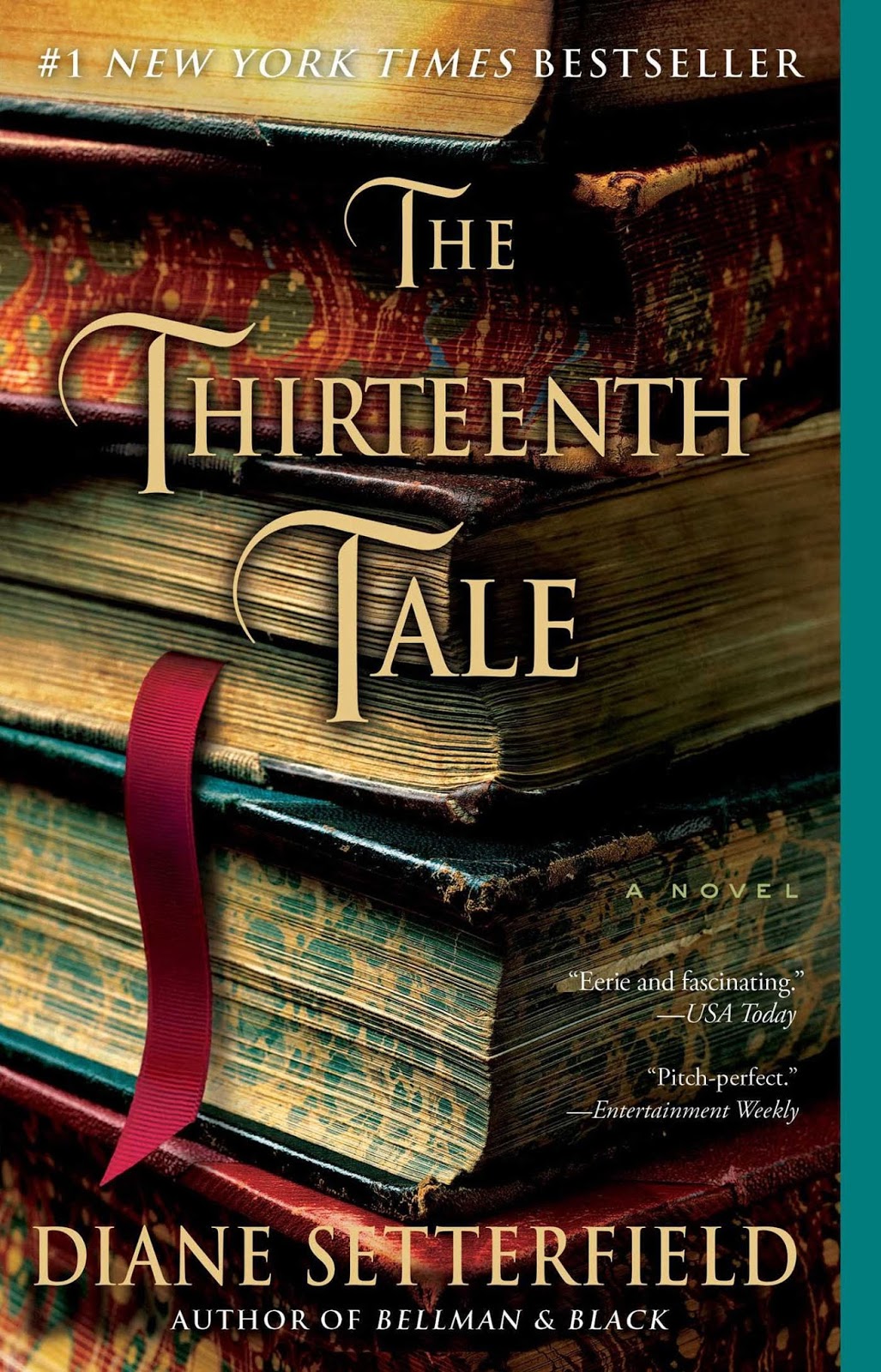
The Thirteenth Tale: A Novel is by Diane Setterfield. This was Setterfield's first book, as far as I can tell, and her second was released 7 years later in 2013. I wonder if this means what I think it does, namely; that she began writing later in her life, and that she spends a fair amount of time writing and re-writing. I'm guessing about the re-writing, but that's based on how well this book was plotted, and how well she maintained the tension, and mystery in the story. And when I finally did figure it out, it was only when Setterfield wanted me too.

Setterfield seems like a reader to me, a trait which is reflected in her protagonist, with whom she shares not only a love of reading, but specifically, a love of older English Romance tales, with a Gothic tilt; think Jane Eyre. And that's how this spooky, mysterious novel feels to me as well. It was a great follow-on for the recent books I've read, especially The Supernatural Enhancements. Setterfield sets a wonderful tone from the very beginning of the book, as she introduces the young, quiet, bookworm of a woman, who lives upstairs from her father's bookshop, and has felt something missing from her live for as long as she can remember. Her relationship with this loss, is almost a comfort to her as she does her researches into the old books in her father's shop, and tries to bring the old authors back into to the light. Wondering all the while whether or not these long-dead authors felt a wisp of acknowledgement, when she opened their forgotten writings.

Her researches capture the attention of a very popular but aging British author who invites the young woman to her mansion so that she can finally tell her life story. The tale of Vida Winter's long and interesting life is slowly spun out, and gets spookier and stranger as time goes along. So strange that the young author goes off to do some investigating of her own, and the story just gets stranger The history of Winter's family includes sudden deaths, possible murder, metal illness, physical abuse, illegitimate births, neglect, a crumbling family estate, mysterious happenings, and you know... a ghost or two.

I enjoyed this one very much and I'll be looking for Setterfield's second novel: Bellman & Black. Read this book.


[edited for English and grammar: 1 Jan 2017. If you see something, say something.]


Thursday, August 25, 2016

return of the king

The Return of the King is the last volume of The Lord of the Rings. I've already read a large portion of this book, when I read the Appendices ahead of time. Of the three volumes, the first is the largest by far. The last is also large, but there are a lot of pages in the appendices; The Return is about the same size as The Towers.

As a closer, Tolkien crushed it with The Return of the King. This is especially obvious when you read about how he got there (which is what I'm reading right now.) There are so many other ideas he had as he wrote this novel, and while I think many think he took too long to write it, the slow thoughtful process is what resulted in the wonderful story we have now.*

While The Two Towers followed two different story tracks in two separate books, The Return brings the storyline (and the fellowship) back together in a lot of ways. Each member of the fellowship also experiences growth as the story progresses. It would have been easy to have supporting characters that act as straight men, or foils to help the author answer questions the readers may have, or to simply add depth (or entourage) to the story, but Tolkien didn't do that, there are no wasted characters here.**

The ring is a bad thing, its pretty clear. What to do with it is the central theme of the book. What do we do with evil when we encounter it? Bury it, overcome it, or destroy it? Each of these options is examined, but also examined are the consequences of each, including the unintended consequences. What if--this book asks--evil things end up spawning wonderful things, should those things be destroyed with the evil if uncoupling them proves impossible?

That's a hard question. And its ultimately what differentiates The Lord of the Rings from other books in this genre. In every era of Middle-earth, since its making, there has been an evil, brought from without, and balanced by a power for good, set firmly against it. At the end of the third era, when that final bit of the original seed of evil is finally rooted out, so also ends the power that was set against it. Which leaves men alone; inheritors of the fourth age, and all the rest of time, with nothing but mythologies, and the intangible but lasting effects of that original evil, to remind us.

Its not just the sorrow of the elves that pangs, its our own as well.

Read this book.


* There are those who think--and I was one of them years ago--that if Tolkien had written quicker, he would have gotten to more of the stories that he contemplated writing. I read somewhere that Tolkien considered The Lord of the Rings the 'end' of the story, essentially, and there was also a beginning story and a middle story (or stories) that could be told.† Many of these stories were ultimately released in The Silmarillion, and various other books Christopher Tolkien edited and published, such as Unfinished Tales, but if we had his father for longer, perhaps he would have completed these stories himself. I guess that's true, but I don't wish that he'd hurried through the LOTR. If he had, we wouldn't love it the way we do, and perhaps wouldn't care if he'd had the chance to finish the other stories he thought about, if they weren't going to be as good as this book ultimately is.

**Those of you that want to argue about Bombadil can do it outside, before I turn the hose on you. I'm talking about the members of the fellowship, who all have a roll to play, big or small. And each character is fully formed. And no I'm not sure how both he and Treebeard can both be first and oldest. Maybe one's first and the other is oldest; does that fix it? 

†  Please don't. Peter Jackson, I'm looking at you.


Tuesday, August 23, 2016

two towers

J.R.R. Tolkien's The Two Towers includes books three and four of the six books that make up The Lord of the Rings. Its fun to re-read old favorites because I find new things in the story that didn't necessarily appear the first or even the second time through. I won't get into specifics about those things, both to avoid spoilers, and because many of those things are just a feeling or a sense that I don't remember in previous readings.

I've also read volume 1 of The History of The Lord of the Rings [part of the larger series; The History of Middle Earth, which has something like 12 volumes.] I read the first volume years ago and I'm currently reading the second, so more on that later, but I will say here is that Tolkien spent years drafting, spit balling, brain storming, outlining, and revising the LOTR. The final story is extremely complex, cross referenced, and maybe most importantly, underlain by a backstory so thoroughly wrought that the book reads almost like a history of real events that may have taken place in our own history or one very similar to our own.

Warning: What follows includes some information from the story, which some may not want to read, if you're trying to know nothing of the storyline beforehand.

Book 3 follows the adventures of a portion of the fellowship, across Rohan and eventually to the tower of Orthanc. Book 4 catches us up on the travels of the ring after the breaking of the fellowship, which takes Frodo to the second of the two towers, in Minus Morgul.* This method of tracking different parts of the story exclusively makes it a little harder to keep track of what is happening consecutively elsewhere in the story, but it does a great job of building suspense and keeping the reader engaged.

The Two Towers doesn't just move the story forward, it includes major plot drivers in the overall struggle between our heroes and the evil they're fighting against.

Yeah, read this book. Its one of my favorites.


* I've never been completely sure which two towers the title referred to, and apparently Tolkien was a little unsure on the subject after having come up with the title. He later settled on Orthanc and Minus Morgul, and even did a drawing for the cover, which is now used on certain re-prints. yeah, that's the one I used, even though that's not what my copy looks like

Saturday, August 20, 2016

fellowship

I'm still playing catch-up from my vacation; I read a few books while I was away and I haven't written about them all yet. One of the things I did do is finish The Hobbit, and the first two volumes of The Lord of the Rings. This is about the first one.

The Fellowship of the Ring is the first volume of The Lord of the Rings, and it contains the first two books. There are six books in all; often broken down into three volumes,* other times, contained in a single volume. The last time I read it, I read a single volume copy. Its a little cumbersome in size, and is slightly different in very minor ways from the three volume version. There are no synopses** necessary in the single volume, as there are at the beginnings of the second and third volumes. When reading the separate volumes, there is no easy access to the Appendices, which are included at the end of the third volume only. And there is also no easy access to the introductory matter, which is included at the front of the first volume.

If you're strict about spoilers, be forewarned that I'm about to mention some elements of the storyline, but there won't be any dramatic reveals of information.

Fellowship begins by catching us up on what Bilbo Baggins has been up to since his adventures chronicled in the Red Book, titled: There and Back Again, better know as The Hobbit. Bilbo's adventures have left him rather well off, and quite comfortable. His old friend, Gandalf the Grey continues to visit him, being concerned as ever with the doings in the Shire, the small, quiet country tucked away on the East-West road, on the way to the Havens. But in the years since their adventure to the Lonely Mountain, Gandalf has been concerned about a quietly rising menace in the world, and it takes a number of years before things actually begin to move in ways that raise his concerns, for not only the Shire, but for all free peoples, everywhere.

Fellowship tells the story of how those feelings of dread finally break upon the sleepy Shire, and Gandalf, and his hobbit friends find themselves in terrible danger, seemingly far beyond their ability to cope with, but as Gandalf has always asserted, hobbits are made of far tougher stuff than their outward appearance may convey.

The wise have determined that by power alone, they can not overcome this evil. It now falls to the hobbits, and a fellowship representing the other free peoples of Middle-earth, to take it upon themselves to do what they can to save Middle-earth from the rising evil in the east.

Of course you should read this book. This is just the first volume of course, and when you're done, you should put it on your shelf so you can read it again. and don't say, I saw the movies. if you saw the movies you don't know the lotr


*  Don't call it a trilogy, Tolkien was pretty clear about that, its a single novel broken down into three parts.
** The synopsis in the second volume, actually includes information that didn't yet occur in the story. It actually takes place in the first part of the second volume. If its your first time through, you may want to skip the synopses all together (for this reason alone!) If you're planning to read all three volumes straight through, you probably won't need any reminders.


Saturday, February 6, 2016

system of the world

The System of the World is the third and final volume of The Baroque Cycle, by Neal Stephenson, and baroque is right. I've never read a story so ornamented, festooned, and gilded as this trilogy. Stephenson seems to have gotten lost in the research of the period, and then in the minutiae of his storyline and its characters. There are letters, secret messages, stories taken from broadsheets, and the text of entire pamphlets and libels, discovered under the feet of the characters as they walked about London in the early 1700s; garlands, embellishments, ornaments, and flourishes, all, to the main story. Stephenson doesn't tell the story, so much as take us there. With all of the stink, coal soot, pockmarks, and horse dung hanging on to us as we wander with him, and learn the details of this story with him. The sub-plots all have sub-sub-plots, and Stephenson juggles them all masterfully.
 
And the cast of characters is enormous; I may have mentioned in my review of the first book that it included a Cast of Characters in the frontmatter. If I hadn't borrowed that volume from the library, I may have gone back to it a few times, as nearly everyone has a title, or two. Just keeping track of the Natural Philosophers alone is difficult enough, never mind the lords and ladies, French, English, German, and other wise, soldiers, pirates, vagabonds, and thieves, clock-makers, counterfeiters, jailers, and executioners. No character is so minor, that we don't learn a little bit about him or her, and perhaps their family.

I was reminded of Herman Melville in some of the detail Stephenson provided, altho I'm happy to report there are few whole chapters dedicated to the history, construction and use of harpoons. Stephenson himself honors two novelists in his acknowledgements--a multi-page affair in the backmatter-- Alexandre Dumas, and Dorothy Dunnett. I don't know Dorothy Dunnett, but I'm going to look her up based on this mention alone.

Not everyone is up for a 3000 page novel, so you need to in it for the long haul. This is a novel form that seems to be designed to entertain, night after night, in the years and centuries before television and movies. I can imagine dark, candle-lit nights, coal fires and quiet reading for an hour or two before bedtime. If you are that type of reader I'm looking at you Chuck then read this book. All three of them.

Sunday, January 17, 2016

confusion

I'm happy to report that the second volume in The Baroque Cycle trilogy wasn't just a wavy line connecting the beginning and the end of the story arc. In fact Stephenson "con-fused" two books together to make up this middle volume. If I remember correctly the first volume was made up of three books so The Confusion is made up of books 4 and 5. Contrast this technique to that of The Two Towers for example which follows on the end of the The Fellowship of the Ring by following some members of the fellowship for an entire book before we ever get to find out the fate of the other members of the fellowship in the second half (book four) of that volume. Not so in this case. More or less instant gratification! no lines, no waiting

Stephenson has woven a complex tale that continues to span years, even decades, dogging the varied and often crossing paths of this enormous cast of characters as they move even further afield. This volume truly spans the early world; at a time when circumnavigating the world was still a new, rare thing.

This installment brings us some answers to questions raised in the first volume. Always a preference to endless teasing in a trilogy. But it also makes new connections and raises new questions, so has me looking forward to the last volume, which I've just taken out from my library.

Stephenson knows what a reader needs and moves the storyline forward at a steady rate. The beginnings of the first volume seemed slow but with a story this epic, it's like an ocean tanker, it takes a while to get it going. This is a fun take on historical fiction, and has some of that snarky inserting of modern slang into the mouths of Enlightenment Era characters. But it doesn't seem like Stephenson uses this technique to ignore the history, it feels like he's done the research and there are strong bones holding up this epic farce.

And Baroque indeed! Festoon away, my depilated penman!

Friday, October 16, 2015

strange and norrell

Jonathan Strange & Mr. Norrell has been around for a few years but I haven't read it until now. I'm sure I've seen it, especially when it came out; its distinctive white-on-black book jacket, formidable size, and intriguing title. I saw it again just recently while browsing the titles in a tiny library in western Massachusetts, and I took a look through. Seems like my kind of book, so the next time I visited my own library, I picked it up.

Formidable is right! This beast is 782 pages and I'm about half way through it at this point. Susanna Clarke has taken it upon herself to write a 'historic' novel about the re-invigoration of English magic at the time of the Napoleonic wars, in the style of the era. What this means is that each of the chapters is titled, the story is carefully conceived, and told in that slow, deliberative style the seems well suited to you people of comfortable means, who may sit in a parlour and read to one another for a few hours each day to pass the time between tea and dinner whilst the servants busy about, out of sight

Think serial, a la The Count of Monte Cristo.

Just not as exciting.

I'm hopeful that second part of this tome has some action. It's been a little thin thus far, but I can see the chess pieces being set about the board, so there is plenty of opportunity for it. Let's bring it home Susanna!

More to come.